
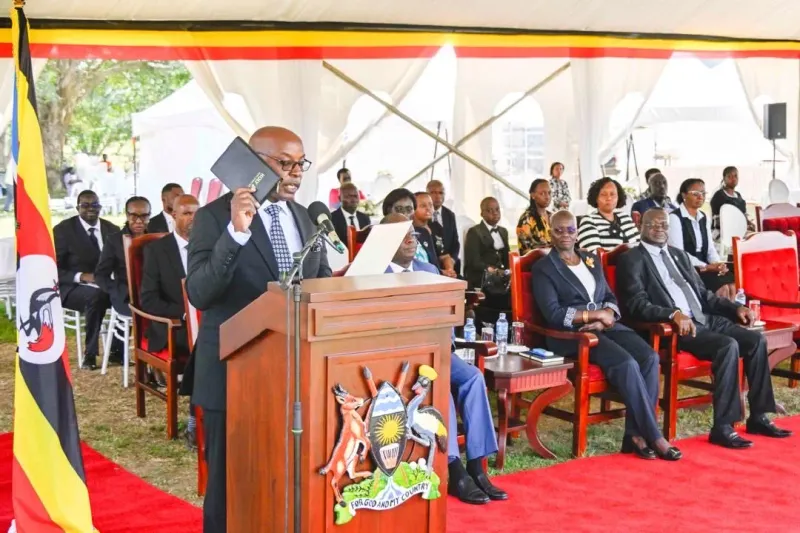
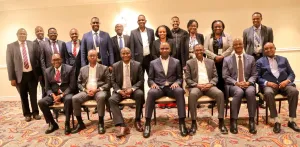

President Yoweri Kaguta Museveni has commended increased collaboration within Uganda’s Judiciary, saying it has contributed significantly to national stability and improved public service delivery. The President made the remarks on Saturday while presiding over the swearing-in ceremony of Dr Flavian Zeija as the new Chief Justice of Uganda.
The ceremony took place at President Museveni’s country home in Kisozi, Gomba District, and was attended by several senior government officials, including the First Lady and Minister of Education and Sports, Maama Janet Museveni.
In his address, President Museveni reflected on the evolution of the Judiciary since the National Resistance Movement (NRM) assumed power. He said the NRM’s focus on patriotism, stability, and socio-economic transformation had enabled better coordination between the Judiciary and the Executive, strengthening governance and institutional efficiency.
The President also praised the outgoing Chief Justice, His Lordship Alfonse Owiny-Dollo, for his role in advancing judicial reforms. He cited initiatives aimed at rationalising court operations and streamlining procedures, which he said had enhanced efficiency within the justice system. Museveni further highlighted the Judiciary’s growing use of Alternative Dispute Resolution (ADR), noting that integrating traditional justice mechanisms with formal court processes has helped reduce case backlogs while promoting reconciliation and access to justice.
President Museveni commended Dr Zeija for his firm stance against corruption, describing corruption as a major challenge to restoring public confidence in judicial processes. He also expressed support for the establishment of a specialised unit to handle government infrastructure-related cases, saying the move would help safeguard public investments and speed up the implementation of national projects.
In his maiden address as Chief Justice, Dr Flavian Zeija acknowledged the weight of leadership in public service and attributed his appointment to God’s grace. He thanked President Museveni for the trust placed in him, noting that this marked his fourth appointment within the Judiciary.
Dr Zeija outlined his vision for Uganda’s judicial system, emphasising efficiency, accountability, and timely case resolution. He said his administration would prioritise strengthening judicial operations, particularly at magistrates’ courts, while addressing issues of absenteeism and underperformance.
He also underscored the importance of setting clear timelines for case disposal and expanding the use of information and communication technology (ICT) to automate court processes, improve monitoring, and enhance evaluation. The Chief Justice reaffirmed his commitment to strengthening Alternative Dispute Resolution mechanisms, which he said are essential in reducing delays and promoting amicable settlements.
Dr Zeija further pledged to prioritise the welfare of judicial officers through enhanced training and institutional support. He emphasised the need for the Judiciary to adapt to global technological developments, revealing plans to train judges in emerging fields such as artificial intelligence. He also disclosed plans to transform the Industrial Court into a paperless institution supported by functional laptops and reliable internet connectivity.
The new Chief Justice stressed that his tenure would be characterised by zero tolerance for corruption, a stance he said is critical to restoring public trust in the Judiciary.
Deputy Attorney General Jackson Kafuuzi, who represented the Minister of Justice and Constitutional Affairs, thanked President Museveni for his leadership, which he said has ensured national stability and smooth institutional transitions. He particularly acknowledged the President’s role in facilitating orderly leadership changes within the Judiciary.
The outgoing Chief Justice, Alfonse Owiny-Dollo, congratulated President Museveni on his electoral victory, saying it reflected broad public support. He also praised Dr Zeija for his energetic and hands-on leadership style, recalling that during his tenure as Principal Judge, Dr Zeija frequently visited courts across the country to gain firsthand insight into operational challenges.
Justice Owiny-Dollo, who retired from the Judiciary on Sunday after attaining the mandatory retirement age of 70, attributed many of the improvements during his tenure to increased funding. He appealed to the government to further enhance the Judiciary’s budget to ensure that every district is staffed with a Chief Magistrate, strengthening access to justice at the grassroots.
Before his appointment as Chief Justice, Dr Flavian Zeija served as Deputy Chief Justice and Principal Judge, having risen through the judicial ranks since his first appointment as a High Court Judge in 2016.



Sunrise reporter
Leave a Comment
Your email address will not be published.