



The Ministry of Agriculture, Animal Industry and Fisheries (MAAIF) has stepped up efforts to transform Uganda’s agriculture sector, urging district leaders to improve service delivery, support farmers, expand irrigation and strengthen access to profitable markets.
The call was made on Wednesday, during a two-day engagement between MAAIF and district leaders at Imperial Royale Hotel in Kampala, where Government officials outlined strategies for turning agriculture into a more productive and commercially driven sector.
The engagement brought together local government leaders, agricultural stakeholders and technical officers to examine challenges affecting farmers and discuss how national agricultural priorities can be better implemented at district level.
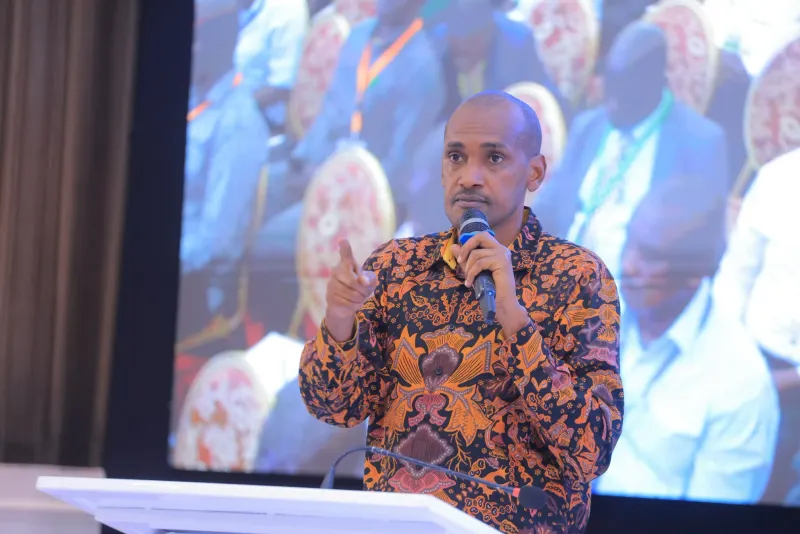
MAAIF Permanent Secretary Maj Gen David Kasura Kyomukama said the farmer must remain at the centre of Uganda’s agricultural transformation.
He said the country's transition to commercial and market-driven agriculture will depend on leaders understanding farmers’ needs and ensuring that Government interventions result in higher productivity, better incomes and improved access to markets.
“The farmer is the most important person in the whole agricultural system,” Kasura said, stressing that Government programmes must translate into practical benefits at community level.
He urged local governments to strengthen agricultural extension, farmer education and coordination while making efficient use of available resources.
Kasura also highlighted the need for farmers to access quality seed and planting materials, improved livestock genetics, mechanisation, irrigation, post-harvest handling, value addition, quality assurance and markets.
He challenged district leaders to identify practical solutions to problems in their areas rather than focusing only on demands for additional resources.
Agriculture Minister Frank Tumwebaze called on district leaders to provide accurate and verified agricultural data to guide Government planning, particularly the proposed National Irrigation Development Project.
Tumwebaze said less than 2% of Uganda’s agricultural land is currently under irrigation, compared with about 3.5–4% in Sub-Saharan Africa and 28% in Northern Africa.
With weather patterns becoming increasingly unpredictable, he said Uganda can no longer depend entirely on rainfall to sustain agricultural production.
The proposed irrigation project is expected to include on-farm water conveyance where reliable water sources already exist, irrigation systems around seasonal rivers and streams, rehabilitation of non-functional irrigation schemes and bulk water systems for water-stressed communities.
The plans also include fish ponds in areas such as Bukedi, Busoga, Luwero and Kigezi, as well as increased agricultural machinery.
Tumwebaze said MAAIF is finalising a project concept for submission to the Ministry of Finance and urged districts to provide verified information on existing irrigation facilities and last-mile water connectivity.
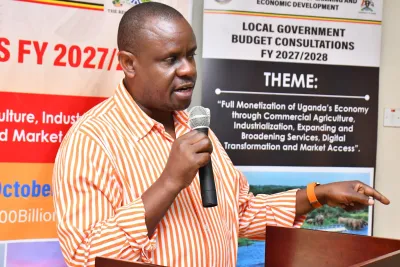
Tumwebaze also challenged district leaders to address gaps in agricultural extension services.
He identified staffing, mobility and facilitation as important factors in ensuring that extension workers reach farmers effectively.
Districts were urged to account for vacant extension positions, available wage provisions, transport for extension workers and the use of Government-provided motorcycles and vehicles.
Tumwebaze questioned why some farmers continue to report inadequate access to extension services despite improvements in staffing and mobility.
He called for stronger supervision, regular farm visits and greater use of radio platforms to promote good agricultural practices.
He also directed MAAIF’s extension department to update his earlier circular on extension roles into a comprehensive extension services handbook.
Meanwhile, Minister of State for Animal Industry Dr Bright Rwamirama urged district leaders, veterinary officers and farmers to strengthen the fight against Foot and Mouth Disease (FMD).
Rwamirama said FMD affects cattle, pigs, sheep and goats and threatens livestock production, farmer incomes and access to better-paying markets.
He said Government has shifted to a cost-recovery approach for FMD vaccination, with farmers contributing Shs8,000 for each cattle or pig and Shs4,000 for each sheep or goat, while Government covers other vaccination costs.
Government has also procured 44 million doses of FMD vaccine and strengthened the vaccine cold chain across districts.
Rwamirama said FMD vaccination will be conducted twice a year, during January-February and July-August, and called on farmers and local leaders to embrace the programme.
“If we have to develop tenfold and transform our economy, we must do things differently,” he said, emphasising that controlling FMD requires cooperation between the Ministry, district leaders, veterinary officers and farmers.
Rwamirama linked FMD control directly to Uganda’s ambition of accessing more profitable livestock markets.
He said Uganda is targeting markets where beef could fetch about Shs60,000 per kilogram, compared with approximately Shs17,000 per kilogram locally.
He argued that disease control is therefore not simply an animal-health issue but also an economic concern because disease restrictions can prevent farmers from selling their animals and limit access to lucrative markets.
Rwamirama urged farmers to regard vaccination as an investment in their livestock businesses and called for stronger compliance with disease-control measures.
He also warned against the illegal sale or diversion of Government vaccines, saying veterinary officers involved in such practices should face arrest and prosecution.
The three MAAIF officials presented different parts of the same broader challenge: ensuring that Government agricultural policies produce tangible results for farmers.
While irrigation is intended to reduce dependence on unreliable rainfall, stronger extension services can help farmers improve production practices. Better disease control can protect livestock and open access to higher-value markets, while reliable agricultural data can help Government and districts plan investments more effectively.
Kasura urged local leaders to know the production figures and agricultural potential of their respective areas, while Tumwebaze stressed that accurate information is essential for national planning.
The engagement therefore places greater responsibility on district leaders and technical officers to strengthen implementation, supervision and coordination at community level.
For farmers, the broader message from the engagement is that Uganda’s agricultural transformation will depend not only on Government programmes but also on how effectively those programmes reach farms, livestock keepers and agricultural businesses.
MAAIF is now calling for closer cooperation between national and local governments, extension and veterinary officers and farmers to improve productivity, protect livestock, expand market opportunities and make agriculture a stronger driver of Uganda’s economy.




Sunrise reporter
Leave a Comment
Your email address will not be published.