
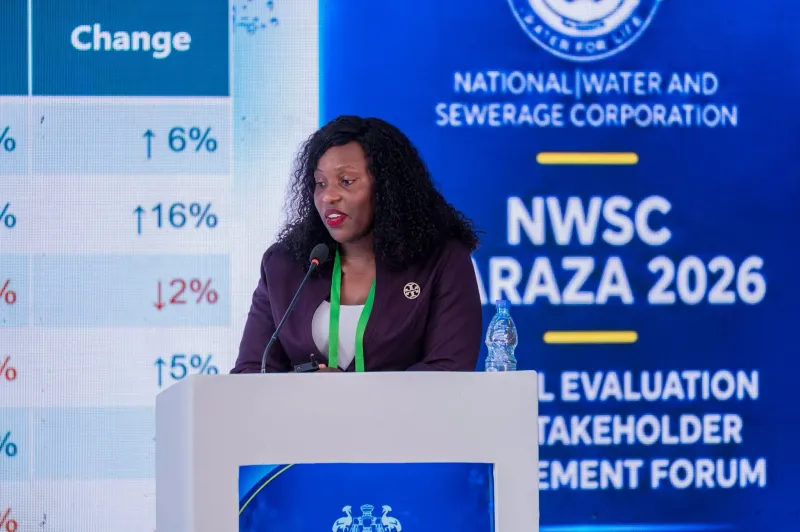




The National Water and Sewerage Corporation (NWSC) expanded its water network by 1,024 kilometres in the 2025/2026 financial year, more than doubling its annual target, as the corporation stepped up efforts to extend water services to more communities across Uganda.
The achievement was among the key highlights presented during the NWSC Baraza 2026 at IREC Bugolobi, where the corporation reviewed its performance, discussed service delivery challenges and engaged stakeholders on measures to improve access to safe, reliable and affordable water.
According to Anna Nyadoi, Principal Economist at NWSC, the corporation achieved 205 per cent of its annual target of extending the water network by 500 kilometres, reflecting continued investment in infrastructure under its Strategic Plan 2025–2030.
The corporation also installed 62,226 new water connections against a target of 60,000, bringing more households, businesses and other customers onto its water supply network.
The expansion contributed to an increase in NWSC's customer base from approximately 1.004 million to 1.064 million connections, representing growth of about six per cent. The population served also increased from 19 million to 22 million people, achieving 105 per cent of the corporation's target.
The latest performance figures highlight NWSC's efforts to expand access to water as Uganda's urban centres continue to grow and demand for reliable water and sanitation services increases.
NWSC has expanded its operations from serving three designated towns to operating in 293 urban centres across different regions of the country, reflecting the corporation's growing role in delivering water services to urban communities.
However, the corporation's leadership says that expanding water distribution networks must go hand in hand with investments in water production and supply capacity to ensure that the infrastructure delivers reliable services to consumers.
Speaking during the NWSC Baraza 2026, Managing Director Dr Silver Mugisha said rapid urbanisation and the development of new residential and commercial areas were increasing demand for water, requiring the corporation to extend its networks, install larger pipes and upgrade existing infrastructure.
“As towns expand, demand for water increases. We must extend our networks, lay larger pipes and upgrade infrastructure to meet this demand,” Mugisha said.
He explained that the corporation was committed to extending water services to more people, reducing the distances communities travel to access water and improving public health and productivity.
Mugisha also emphasised the importance of working closely with local leaders to identify community needs, address service delivery challenges and ensure that infrastructure investments translate into tangible improvements for consumers.
He said NWSC intends to hold stakeholder engagements every six months to strengthen coordination, review performance and discuss practical solutions to concerns affecting communities served by the corporation.
The Baraza provided an opportunity for leaders and other stakeholders to receive updates on completed, ongoing and planned infrastructure projects, while raising concerns about water availability, network expansion and the effects of construction works.
Mugisha acknowledged concerns over road excavations associated with the installation of water pipelines but called for public understanding and cooperation as the corporation undertakes infrastructure projects intended to extend services to more communities.
“We appeal for the public’s understanding and support as we undertake infrastructure works necessary to extend water services to more communities,” he said.
Despite the progress in network expansion and customer growth, NWSC faces challenges in reducing water losses, with non-revenue water increasing during the reporting period.
The corporation's non-revenue water level rose from a baseline of 33.7 per cent to 34.4 per cent, falling short of its target of reducing the figure to 32 per cent.
Non-revenue water refers to treated water that does not generate revenue for the utility, often because of leakages, illegal connections, metering inaccuracies and other operational losses.
The increase highlights the need for stronger measures to detect and repair leaks, improve metering accuracy, address illegal connections and strengthen the efficiency of water distribution systems.
Reducing these losses is important because water produced and treated at a cost but lost before generating revenue places additional pressure on the corporation's operations and can limit the amount of water available to paying customers.
NWSC also reported an employee engagement index of 78.2 per cent, equivalent to 98 per cent achievement of its target. The corporation identified staff engagement as an area requiring continued attention to improve workplace satisfaction and organisational performance.
On the customer front, however, the Customer Engagement Index improved from 79 per cent to 82 per cent, representing 103 per cent achievement of the target.
The improvement suggests progress in strengthening relationships with customers and responding to the concerns of communities that depend on NWSC for water and sanitation services.
The corporation also recorded strong financial performance, posting an annual turnover of Shs 678 billion in the 2025/2026 financial year, representing 119 per cent achievement of its target and a five per cent increase over the baseline year.
Its infrastructure asset base grew from approximately Shs 4.8 trillion to Shs 5 trillion, achieving 102 per cent of the target.
The growth in turnover and infrastructure assets provides an important financial and operational foundation for continued investment in water networks, service improvements and the expansion of operations across urban centres.
However, challenges in Kampala and the Central Region affected the pace of network expansion in some areas, according to the performance presentation. Inadequate water supply constrained progress in certain locations, highlighting the importance of increasing production capacity alongside the construction of new distribution networks.
The corporation recognises that installing more pipes and creating additional connections cannot, on their own, guarantee reliable water supply where production and distribution capacity remain insufficient.
Addressing the constraints will therefore require coordinated investment in water sources, treatment and production facilities, transmission infrastructure and distribution networks to ensure that the growing number of customers receives adequate supplies.
During the Baraza, Mugisha reiterated that access to water is a basic human right and called for collective efforts to make safe, reliable and affordable water more accessible, particularly to communities that continue to experience supply challenges.
He also underscored the importance of accountability and stronger partnerships between NWSC and local leaders, saying that regular engagement would help the corporation understand area-specific concerns and identify priority interventions.
The NWSC Baraza 2026 was held under the theme “Water for All; For Health and Prosperity,” reflecting the corporation's emphasis on expanding water access, protecting public health and supporting sustainable development.
As implementation of its Strategic Plan 2025–2030 continues, NWSC says it will focus on sustaining infrastructure growth, improving operational efficiency, strengthening financial viability and addressing gaps in water supply.
The corporation's latest performance presents significant gains in network expansion, new connections, population served and financial turnover, while persistent water losses and supply constraints remain important challenges.
The extent to which these investments improve the reliability, affordability and availability of water will be central to assessing NWSC's progress towards its goal of providing safe and sustainable water and sanitation services to more Ugandans.







Paul Rubongyera
Leave a Comment
Your email address will not be published.