
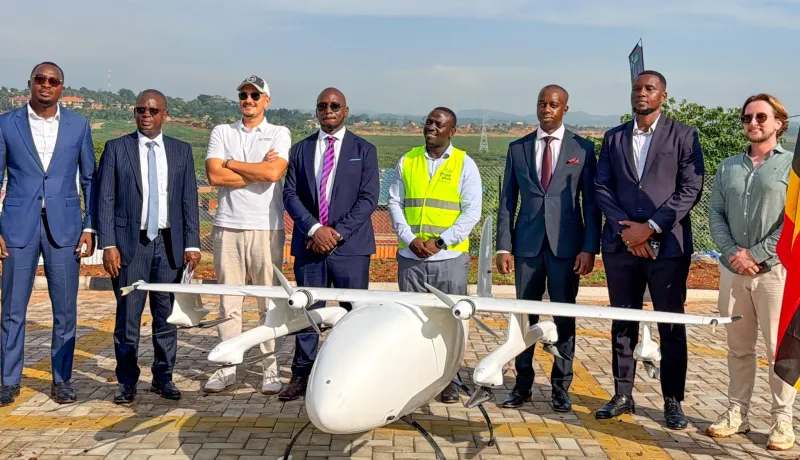




Uganda’s Ministry of Health has launched medical logistics drone operations to improve healthcare delivery in hard-to-reach island communities in Kalangala and Buvuma, with the technology expected to speed up the transportation of laboratory samples, medicines and essential medical supplies.
The initiative is intended to address transportation challenges affecting health facilities serving communities on Lake Victoria, where reliance on boats and road transport can delay the delivery of medical commodities and the transfer of patient samples to specialised laboratories.
The launch was announced by the Ministry of Health and senior health officials, including Permanent Secretary Dr Diana Atwine and Minister of State for Health in charge of Primary Health Care, Dr Charles Ayume.
Dr Atwine said the maiden flight transported laboratory samples from Kalangala to the Central Laboratory at Butabika in Kampala. She said the initiative would accelerate sample transportation, reduce turnaround times and strengthen disease surveillance.
Atwine commended the laboratory team for embracing innovation and exploring new ways of addressing healthcare delivery challenges. She also emphasised the importance of adopting technology to accelerate service delivery.
According to the Ministry of Health, the drone flight involved a route from Butabika to Koome Islands, onward to Kalangala Town Council, before returning to Butabika. The operation carried medical supplies to island health facilities and collected laboratory samples for testing in Kampala.
Dr Ayume said the launch marked an important step towards improving the transportation of essential medical commodities to island communities. The drone carried a payload of up to 15 kilogrammes, including HIV testing kits, vacutainers and other medical supplies.
The technology is expected to help health workers obtain laboratory results sooner by reducing the time samples spend in transit. Faster transportation could support timely diagnosis and enable healthcare providers to make treatment decisions earlier, particularly for patients who depend on specialised laboratory services outside their districts.
The Ministry is also assessing how drone transportation can be incorporated into Uganda’s existing Integrated National Sample Transport Network. Ayume said evidence gathered from the flights would inform decisions on integrating the technology into the national system to strengthen timely and reliable sample transportation from hard-to-reach communities.
The initiative comes amid efforts to address longstanding logistical difficulties in Kalangala, where health facilities serving scattered islands depend on water and road transport to move samples to laboratories in Kampala.
The Ministry’s National Health Laboratory and Diagnostic Services Department had conducted test flights to assess the drones’ performance and suitability for transporting medical supplies and laboratory samples across the islands before the launch.
The flight data is expected to guide preparations for deployment and help determine how the technology can complement existing healthcare logistics arrangements.
If successfully integrated into the national sample transport network, medical drones could provide an additional means of reaching geographically isolated health facilities, improving the movement of essential supplies and supporting disease surveillance.
The Ministry’s initiative forms part of broader efforts to use technology to address barriers to healthcare access and improve the delivery of health services to communities that are difficult to reach through conventional transport systems.






Sunrise reporter
Leave a Comment
Your email address will not be published.