
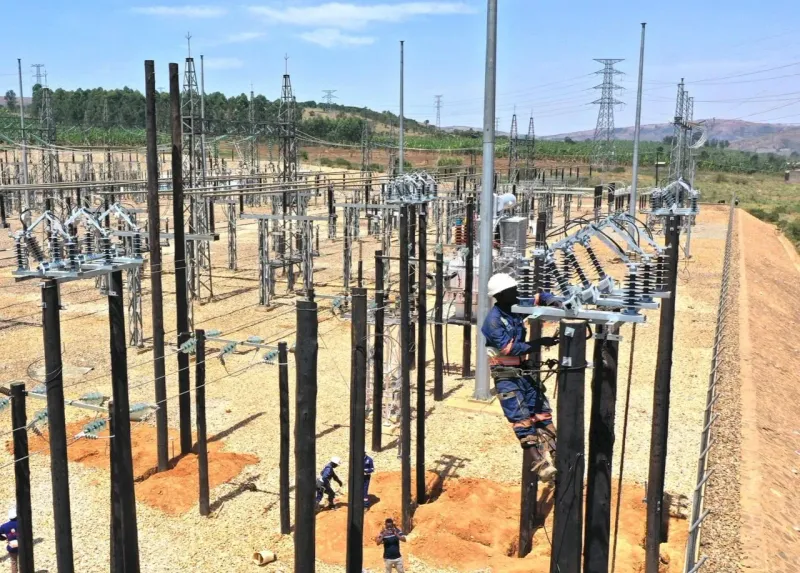




More than 30,000 households and 700 commercial consumers in Isingiro, Ntungamo, Rukungiri and parts of Rwampara are expected to benefit from improved electricity reliability following the integration of the Mirama Hills Substation into Uganda’s distribution network.
The upgrade is expected to strengthen power supply in the four areas while creating additional capacity for businesses and industries whose electricity demand is growing.
The works involve the installation of a 15MVA transformer by the Uganda Electricity Transmission Company Limited (UETCL) and the restructuring of the existing Kikagati–Ntungamo feeder to create more efficient electricity supply routes.
The works started in August 2026 and are expected to be completed by mid-September, according to the project announcement.
The intervention is designed to address limitations in the existing distribution arrangement by improving how electricity is routed to consumers in the affected districts.
The restructuring of the Kikagati–Ntungamo feeder is also expected to reduce technical losses and improve the quality and reliability of electricity reaching homes, businesses and industrial users.
The project comes as electricity demand continues to rise across western Uganda, particularly around emerging industrial and agro-processing investments.
UEDCL's Southern Service Territory includes Isingiro and Ntungamo, among other districts, reflecting the importance of the region to the company's distribution operations.
Another objective of the project is to improve the evacuation of electricity generated by the Kikagati Hydropower Plant.
Kikagati is part of the wider electricity infrastructure around Mirama Hills. The Mirama–Kikagati–Nsongezi transmission corridor was developed to facilitate the evacuation of electricity generated by hydropower plants in the area into the national grid.
Kikagati Hydropower Station has a generation capacity of about 16 megawatts, while the wider transmission infrastructure also connects with electricity generation from the Nshungyezi project.
Improving the network around Mirama Hills is therefore expected to help make better use of available generation while strengthening supply to consumers in the surrounding region.
One of the major expected beneficiaries is Terra Industrial Development Company, an iron-processing facility in Ntungamo whose estimated electricity demand is about 7MVA.
The development comes as Uganda seeks to increase local processing and value addition rather than exporting raw minerals.
Terra's iron ore processing factory in Rwenanura, Ntungamo, has been presented as an important investment in the country's mineral value-addition drive. Recent reports have described the facility as producing pig iron with purity of up to 93 percent.
The additional electricity capacity will therefore be important for industries such as Terra that require substantially more power than ordinary domestic or commercial consumers.
The electricity upgrade also comes against the backdrop of expanding agro-processing activity in Ntungamo.
The Africa Coffee Park, operated by Inspire Africa Group, is based in Ntungamo and is focused on processing and adding value to Ugandan coffee. The company says the facility includes a freeze-drying coffee plant and other coffee value-addition activities.
The coffee park has previously been linked to government efforts to strengthen electricity infrastructure for industrial activity in the district. In 2025, Parliament approved funding that included Shs7 billion for a dedicated power line in Ntungamo connected to industrial developments.
The development of stronger electricity infrastructure is consequently becoming increasingly important as Ntungamo attracts investments that require reliable, high-capacity power.
For households, improved network configuration is expected to translate into more reliable electricity supply and better power quality.
For commercial consumers, the additional capacity could help reduce disruptions that affect business operations, while industries stand to benefit from a network better suited to heavier electricity demand.
The project is also intended to reduce technical losses in the distribution system, potentially improving the efficiency with which available electricity reaches consumers.
The upgrade is expected to strengthen the region's electricity network and provide additional capacity for households, businesses and industries.
The investment highlights the growing link between reliable electricity infrastructure and Uganda's industrialisation ambitions, particularly in regions where manufacturing, mineral processing and agro-processing are expanding.





Sunrise reporter
Leave a Comment
Your email address will not be published.