



Finance
Musasizi Urges Banks to Accept Intellectual Property as Loan Collateral for Uganda’s Creatives
Uganda’s government has urged commercial banks and financial institutions to accept intellectual property as collateral for loans to help musicians, filmmakers, artists and other players in the creative industry access financing and expand their businesses.
Finance Minister Henry Musasizi said the Security Interest in Movable Property Act, 2019 provides for intellectual property to be used as collateral when accessing commercial bank credit. However, he expressed concern that some financial institutions remain hesitant to implement the provision, limiting creatives' ability to use their intellectual assets to secure loans.
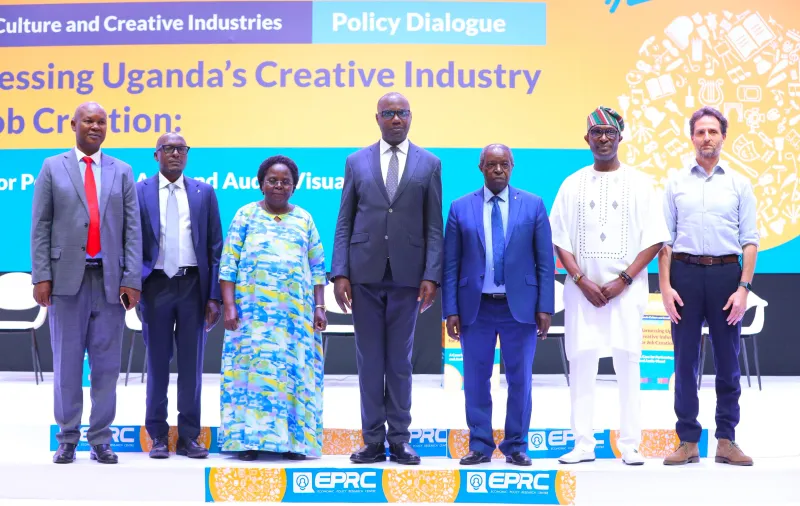
Musasizi made the remarks while officiating as Chief Guest at the Uganda Culture and Creative Industries Policy Dialogue organised by the Economic Policy Research Centre (EPRC) at Serena Hotel in Kampala.
He called for stronger collaboration between government and financial institutions to unlock financing opportunities for the cultural and creative industries, saying access to affordable credit would support business expansion, investment and job creation.
The minister highlighted several government interventions aimed at supporting the sector, including Shs66 billion allocated to the creative industry in the 2025/26 financial year. Of this amount, Shs10 billion was provided for a revolving fund for artists, while the remaining funds were allocated to support creative arts.
Government also provided an additional Shs33 billion to the musicians' revolving fund in the 2026/27 financial year to promote enterprise development and employment opportunities.
Other interventions include a Shs500 million grant extended to filmmakers through the Uganda Communications Commission in 2021, Shs5 billion advanced to the podcasters' Savings and Credit Cooperative Organisation (SACCO) in 2026, and Shs7 billion allocated to support the event promoters' SACCO.
Musasizi said government considers the cultural and creative industries an important sector for strengthening Uganda's economy and increasing domestic resource mobilisation.
He, however, identified informality as one of the major challenges affecting the industry's growth, noting that much of the economic value generated by creatives comes from activities outside registered enterprises.
According to the minister, this means the sector's actual contribution to the economy is considerably higher than what is currently reflected in official national accounts.
He emphasised the need to strengthen data collection systems, improve the classification of creative enterprises and encourage businesses in the sector to formalise their operations.
Such interventions, he said, would help attract investment, improve the measurement of the industry's economic contribution and broaden the country's tax base.
Figures from the 2024 National Population and Housing Census show that Uganda has 353,115 people working in creative occupations, representing 3.7 per cent of the country's total working population.
Government has set targets to increase the creative industry's contribution to Gross Domestic Product (GDP) from 3 per cent to 6 per cent, raise its share of employment from 1 per cent to 5 per cent, and grow its export earnings and domestic revenue contribution by 25 per cent.
Speaking at the same policy dialogue, EPRC Executive Director Dr Sarah Ssewanyana said the creative industry presents an important opportunity for addressing Uganda's youth unemployment challenge through productive and sustainable employment.
She cited statistics from the Uganda Bureau of Statistics indicating that four in every ten young people in Uganda are not in employment, education or training.
Ssewanyana added that approximately seven in every ten people working in performing arts, music, film and fashion are young people, demonstrating the sector's potential to provide livelihoods and business opportunities for the country's youthful population.
She also noted that creative industries have demonstrated resilience amid rapid technological advancement and the growing use of artificial intelligence.
According to her, the sector continues to depend on cultural sensitivity, social skills and individual creativity, qualities that cannot easily be replicated by artificial intelligence.
The government interventions are part of Uganda's Tenfold Growth Strategy, which seeks to expand the country's economy to US$500 billion by 2040.
The push for intellectual property-backed lending is expected to encourage financial institutions to recognise the commercial value of creative assets and expand financing opportunities for businesses operating in Uganda's cultural and creative economy.






Sunrise reporter
Leave a Comment
Your email address will not be published.