



News
Kadaga Dismisses Death Rumours, Blames Social Media Misinformation as She Launches Grassroots Campaign
Former Speaker of Parliament and First Deputy Prime Minister, Rebecca Kadaga, has publicly dismissed widespread social media rumours claiming she had died, describing them as deliberate misinformation driven by individuals seeking financial gain.
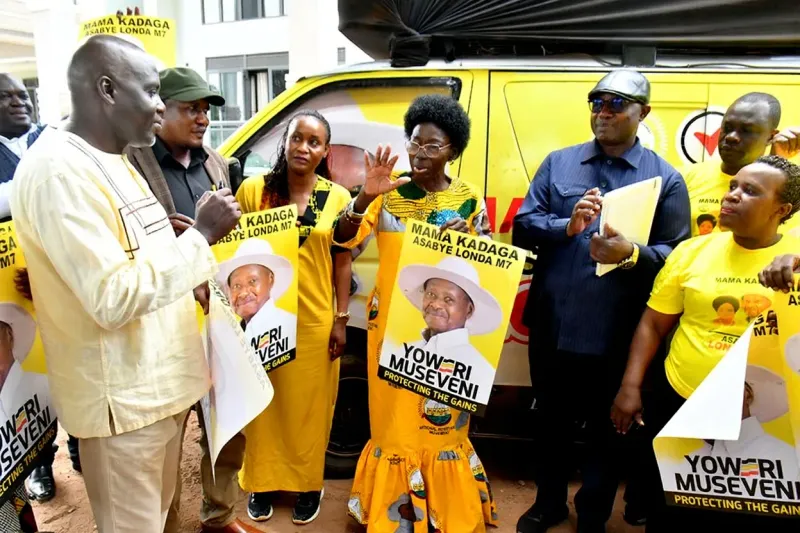
Kadaga made the remarks while officially launching her door-to-door campaign in Busobya Village, Mbulamuti Town Council, within Kamuli District. Her appearance reassured supporters who had grown concerned following persistent online speculation about her health.
“I am alive!” Kadaga declared as she addressed residents, firmly rejecting the claims circulating online. She added, “There are individuals paid to tarnish my personality and, on several occasions, pronounce me dead, but I have always turned up alive.”
Although she did not name those responsible, Kadaga condemned the growing trend of monetizing falsehoods on digital platforms. “It has become a lucrative business for people to earn from spreading false rumours and abusing others via different social media platforms,” she said.
Her return to the campaign trail, marked by supporters riding motorcycles and wearing yellow NRM-branded T-shirts, energized her base and dispelled fears fueled by manipulated images and unverified online reports.
Local supporter Norah Kyemba said Kadaga’s presence restored confidence among voters. “Seeing Kadaga stand and speak to us restores our hope. The AI photos and false claims about her ill health had caused worry, but now we are motivated to mobilize our teams more ahead of election day,” she said.
Another supporter, Roselyn Namaddu, warned against the misuse of social media in political contests, noting that false narratives about a candidate’s health can unfairly sway voter opinion.
Political analyst Wilson Byakika echoed similar concerns, emphasizing that public office does not erase personal rights. “Health matters should only be discussed with consent, between patients and medical personnel, even for public figures,” he said, stressing that medical privacy should be respected unless voluntarily disclosed.
Beyond addressing misinformation, Kadaga used the occasion to remind voters of their civic responsibilities during elections. She urged citizens to safeguard their votes within the confines of electoral laws, noting that regulations require voters to remain at least 20 meters away from polling tables after voting.
Kadaga also assured residents that security agencies would be present to prevent election-related violence and ensure a peaceful voting process.
Her remarks come amid national debate over voter conduct at polling stations following comments by UPDF Deputy Spokesperson Colonel Henry Obbo, who advised voters to leave polling areas after casting their ballots.
“When you finish voting, please go home and wait for the announcement of results or the time of counting. That is when you could go back, instead of crowding polling stations and becoming a security threat,” Obbo said.
The guidance sparked mixed reactions across political parties and civil society, with some religious leaders opposing the directive.
Attorney General Kiryowa Kiwanuka later clarified the legal position, stating that while voters should not remain inside polling stations after voting, the law allows them to stay at a lawful distance.
“I can say without fear of contradiction that after voting, you must not stay at the polling station. When you are 20 meters away, that is not a polling station. Twenty meters, one hundred meters, that is perfectly lawful, but not at the polling station,” Kiwanuka explained.
Kadaga’s appearance not only put an end to rumours surrounding her well-being but also reignited discussions on election security, voter rights, and the growing impact of misinformation in Uganda’s political landscape.
URN




The Sunrise Editor
Leave a Comment
Your email address will not be published.