
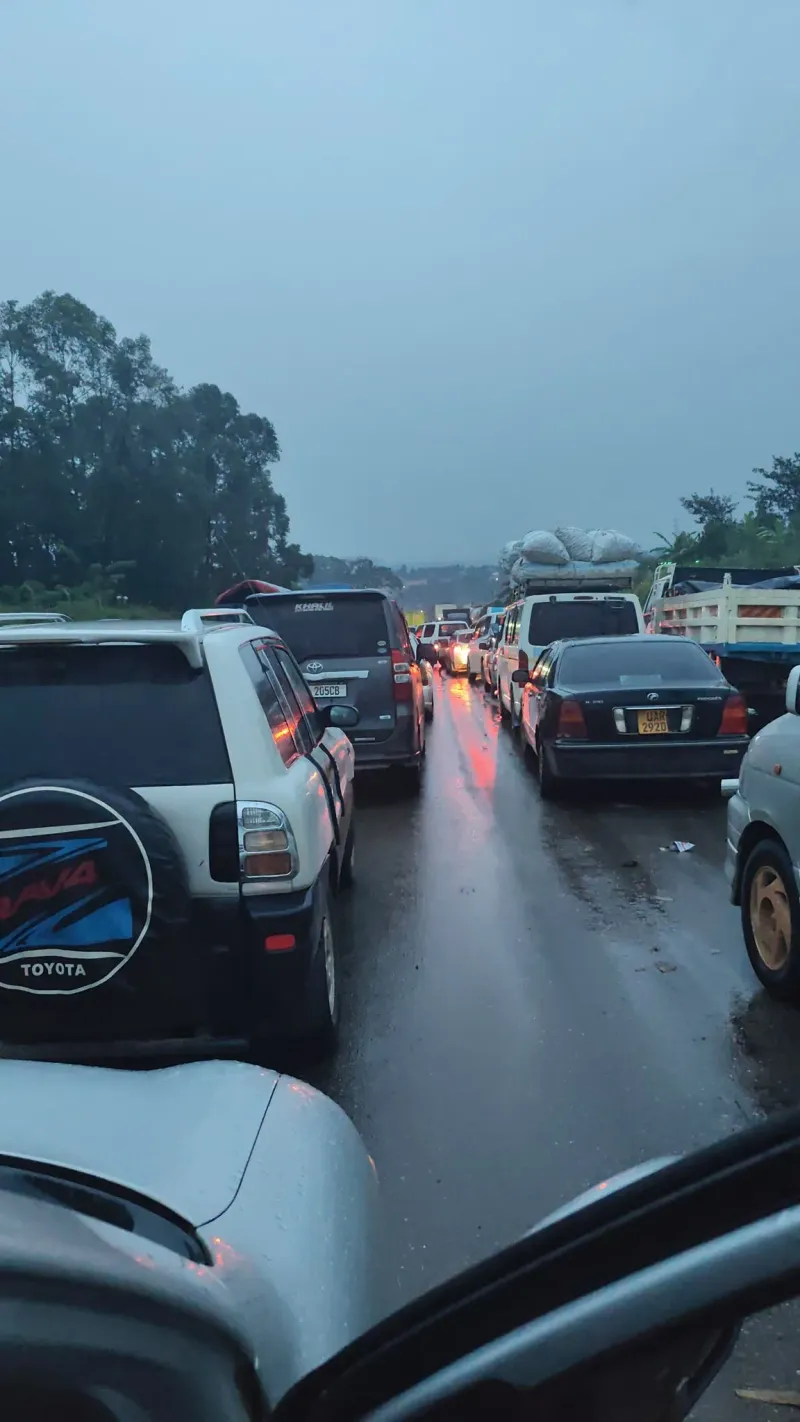
Thousands of motorists returning to Kampala from western Uganda were stranded overnight after a massive traffic gridlock paralysed the Masaka–Kampala highway, with delays stretching beyond 12 hours, according to eyewitness accounts and multiple reports.
The congestion began on Monday afternoon and intensified through the night, affecting large sections of Mpigi, Butambala and neighbouring districts as weekend and holiday travellers converged on the capital. Several news outlets reported that traffic had completely stalled in some sections, forcing travellers to sleep in their vehicles.
Some described the gridlock as the worst they had ever experienced, saying motorists were forced to sleep in their vehicles, some ran out of fuel, and traffic remained stationary for hours.
Other motorists echoed similar experiences with one saing he entered Mpigi at about 4:00 p.m. on Monday but only reached Kampala at 7:00 a.m. on Tuesday, describing a journey marked by exhaustion and uncertainty.
Police Diversions and Ministry Response
By Tuesday morning, Traffic Police and the Ministry of Works and Transport acknowledged the severity of the congestion and issued advisories directing motorists to alternative routes. According to official statements cited by multiple media outlets, diversions were activated after traffic levels became unmanageable.
"Dear motorists, the existing travel Alternatives including the Mpigi—Kasanje—Nakawuka to Entebbe/Kampala [for traffic heading to Kampala] and Mpigi— Kanoni — Gomba—Ssembabule—Villamaria [for traffic heading to Masaka] are beginning to offer some traffic relief.
Alternatively, from Mpigi, one can divert to Kasanje and use the Ferry at Nakiwogo to Entebbe/Kampala.
Traffic officers were deployed along affected sections to restore flow, with authorities urging drivers to maintain lane discipline as congestion gradually eased later on Tuesday.
Political Activities Spark Public Debate
Several motorists interviewed by local media blamed the gridlock on political rallies held in Mpigi and Butambala, saying roadside gatherings and security arrangements worsened the situation during peak travel hours.
However, government officials rejected claims that President Yoweri Kaguta Museveni’s campaign activities were responsible. Officials said the president departed the Mpigi rally by air at around 6:00 p.m., insisting there were no prolonged road closures linked to the presidential convoy.
A Recurring Transport Bottleneck
The incident has reignited debate over traffic management on Uganda’s major highways, particularly the Masaka–Kampala corridor, which frequently experiences congestion during weekends, holidays and major public events.
Transport analysts warn that increasing vehicle numbers, limited alternative routes and uncoordinated roadside activities continue to strain the highway, raising the likelihood of similar disruptions unless long-term infrastructure and traffic planning measures are implemented.

The Sunrise Editor
Leave a Comment
Your email address will not be published.