
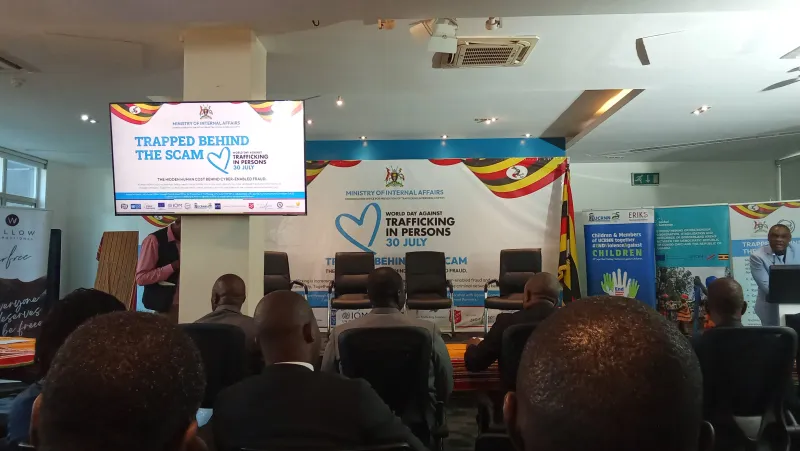





The Government of Uganda has intensified efforts to combat human trafficking by launching a new National Action Plan, as officials warn that criminal networks are increasingly using digital technology to target vulnerable people.
The initiative was launched by Minister of Internal Affairs Prof. Ephraim Kamuntu during Uganda's commemoration of the World Day Against Trafficking in Persons. This year's observance was held under the theme, "Trapped Behind the Scam: The Hidden Human Cost Behind Cyber-Enabled Fraud."
The event also saw the release of the National Report on Countering Trafficking in Persons 2025, which recorded a 6.18 percent decline in reported trafficking cases. According to the report, cases fell from 1,068 in 2024 to 1,002 in 2025.
Despite the overall decline, children continue to account for the majority of trafficking victims. The report shows that 555 of the 1,002 recorded victims were children, representing more than 55 percent of all reported cases, while 447 were adults.
Prof. Kamuntu described human trafficking as a form of modern-day slavery that causes lasting harm to families and communities. He emphasized that protecting children begins at home and urged parents to instill strong moral values to help prevent exploitation.
Officials also highlighted the growing role of digital platforms in facilitating human trafficking. Derrick Kigenyi Basalirwa, Deputy National Coordinator at the Coordination Office for Prevention of Trafficking in Persons, said traffickers are increasingly exploiting online platforms to collect personal data and recruit unsuspecting job seekers. Victims are then coerced into forced criminal activities or remote scams.
Waiswa Abdu Salaam, Head of Legal at the Uganda Communications Commission, warned that while the internet creates opportunities for innovation and employment, criminals are taking advantage of young people searching for jobs. He urged the public to verify online job advertisements and avoid sharing personal information with unverified recruiters.
The report also places Uganda's challenges within the wider African context. Statistics show that about seven million people were living in modern slavery across Africa in 2021, representing 14 percent of the global total. Forced labour and sexual exploitation remain the leading forms of exploitation.
According to the United Nations Office on Drugs and Crime, nearly 79 percent of human trafficking cases in Africa occur within national borders, driven by poverty, high unemployment, armed conflict and weak regulatory frameworks.
Uganda's new National Action Plan adopts a multisectoral approach involving security agencies, civil society organizations and international partners. Guided by the Prevention of Trafficking in Persons Act, 2009, the strategy aims to strengthen prevention efforts, improve victim protection and survivor rehabilitation, promote safe migration and enhance the prosecution of traffickers.
As traffickers increasingly exploit digital technology, government officials say public vigilance, responsible internet use and parental guidance remain essential in protecting vulnerable Ugandans from human trafficking and modern slavery.







Sunrise reporter
Leave a Comment
Your email address will not be published.