






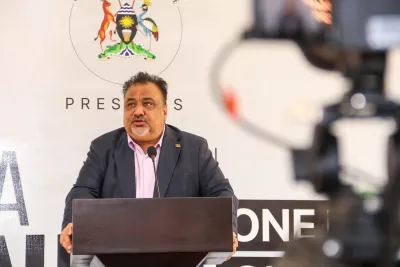
Kampala Lord Mayor Ronald Balimwezo has challenged the government’s proposal to relocate government functions from Kampala to Nakasongola, arguing that Uganda should invest in fixing the capital rather than move away from its urban challenges.
The debate follows remarks by State Minister for Urban Development Margaret Muhanga to Parliament’s Lands and Housing Committee, where she backed a phased relocation of government ministries, departments and agencies to Nakasongola.
According to reports from the parliamentary committee proceedings, Muhanga said the process could run until 2040 and argued that Kampala’s congestion and urban-planning problems have become increasingly difficult to address. Nakasongola, she said, offers an opportunity to develop a planned administrative centre from the ground up.
Balimwezo, however, says such a major change cannot be treated as a simple administrative announcement.
In a statement dated August 14, he called for public participation and consultation, particularly involving the people of Kampala, while also pointing to the constitutional and legal questions surrounding any change to the status of the capital.
The debate comes against the backdrop of Uganda’s existing legal framework.
Article 5 of the Constitution provides that Kampala is the capital of Uganda. The Kampala Capital City Act subsequently declares Kampala the capital city in accordance with Article 5 of the Constitution.
This means the current discussion raises an important distinction between relocating government institutions and formally changing Uganda’s constitutionally designated capital.
Recent reports have described the proposal in terms of moving ministries, departments and agencies to Nakasongola, while Balimwezo's statement refers more broadly to changing the capital.
Rather than moving away from Kampala, Balimwezo wants government to address the city’s infrastructure and service-delivery challenges.
He called for greater investment in roads, public transport, waste management, housing and other urban infrastructure.
He also pointed to proposed mass-transit solutions, including Bus Rapid Transit, trains and a metro system, arguing that Kampala needs sufficient funding to implement such projects and reduce congestion.
KCCA itself has a five-year Strategic Plan for 2025/26–2029/30 valued at Shs11.9 trillion. The plan includes investments aimed at transforming Kampala into a better-planned and more resilient city, with financing expected from several sources including central government transfers, climate finance and public-private partnerships.
Balimwezo said in his statement that KCCA requires a Shs2.4 trillion annual budget but receives only about 40 percent of that amount. Those figures are claims made by the Lord Mayor and have not been independently verified in this report.
Government's argument is centred largely on Kampala's congestion and the possibility of developing a new administrative centre in a less densely populated area.
Muhanga has argued that Nakasongola offers land and an opportunity to build a planned city rather than attempting to address the problems that have accumulated in Kampala over decades. Reports from the parliamentary discussion indicate that the government is considering a phased approach rather than an immediate relocation.
The minister has also said the development of a new administrative centre would not mean the disappearance of Kampala as Uganda's commercial centre.
That leaves the debate centred on a larger policy question: whether Uganda should attempt to relieve pressure on Kampala by relocating government functions, or whether the same resources should instead be used to transform Kampala while developing other cities.
Balimwezo has stressed that opposing the proposal does not mean opposing the development of other Ugandan cities.
He supports decentralisation and says cities across the country should receive adequate government funding and infrastructure investment.
His position is that developing Nakasongola and other urban centres should happen alongside investment in Kampala rather than at the expense of the capital.
“The solution is not to abandon Kampala,” Balimwezo said, arguing that Kampala should be developed while other cities are strengthened and properly funded.
He also called for discussions involving government ministers, Kampala leaders, Members of Parliament and other stakeholders.
The proposed shift has now opened a broader debate about how Uganda should manage urban growth, government administration and investment.
For Balimwezo, the issue is not simply whether another city can accommodate government offices. He argues that decisions affecting Kampala should involve the people who live and work there as well as Ugandans more broadly.
“Kampala belongs to all Ugandans,” he said, calling for inclusive dialogue, consultation and a shared national vision.
For now, Kampala remains Uganda’s capital under the Constitution and the Kampala Capital City Act. The emerging proposal to develop Nakasongola as a new administrative centre therefore presents both a policy and legal question that could require further clarification as government develops its plans.
The debate is likely to continue around two competing approaches: investing in Kampala to address congestion and infrastructure problems, or creating a new administrative centre in Nakasongola and gradually moving government functions there.





Marlene Luwedde
Leave a Comment
Your email address will not be published.