
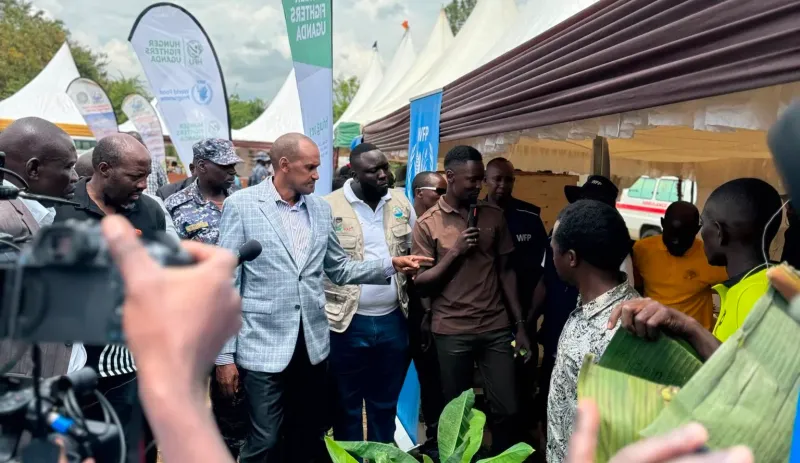




Uganda’s Minister of Agriculture, Animal Industry and Fisheries, Frank Tumwebaze, has called on agricultural stakeholders to embrace scientific research, innovation and climate-resilient farming practices to improve food security, increase farmers’ incomes and protect the environment.
Tumwebaze made the call while delivering his keynote address at the national World Food Day celebrations held at the Mbarara Zonal Agricultural Research and Development Institute (MBAZARDI) on Friday, October 16, 2026.
The minister highlighted Uganda’s agricultural potential, noting that the country has vast opportunities to increase production by making better use of its available land and natural resources.
“God blessed Uganda with over 40 million acres of arable land and we have only using less than 2 million. As a country, we have vast opportunities in terms of resources,” Tumwebaze said.
He urged stakeholders across the agricultural sector to pursue development while balancing four key priorities: food security, income security, animal feed security and environmental security.
According to the minister, agricultural development should not focus solely on increasing food production but should also improve household incomes, ensure adequate feed for livestock and promote sustainable management of natural resources.
Tumwebaze reaffirmed the government’s commitment to agricultural research and resilience, calling on scientists to develop practical solutions that address the challenges faced by farmers.
He applauded researchers whose work directly improves livelihoods and encouraged more agricultural scientists to focus on innovations that can be adopted by farming communities to increase productivity and incomes.
“Together, we must continue to promote and embrace research that is applicable and can directly improve the livelihoods and incomes of our people,” he said.
The minister described World Food Day as an important platform for connecting farmers with agricultural research, scientific knowledge and new technologies. He noted that the event enables farmers to interact with researchers and explore improved crop varieties, animal breeds and other innovations that can support agricultural production.
He also congratulated MBAZARDI on reaching its 100-year milestone, recognising the institute’s contribution to agricultural research, improved animal breeds and the adoption of new farming technologies.
The institute, which traces its origins to a livestock breeding centre established in 1926, operates under the National Agricultural Research Organisation (NARO) and conducts research into crops, livestock, agroforestry and aquaculture relevant to south-western Uganda.
Addressing the challenges posed by changing weather patterns, Tumwebaze urged researchers and agricultural scientists to continue developing tools and technologies that help farmers adapt their production methods to prevailing climatic and environmental conditions.
He emphasised the need for innovations that can help farmers maintain productivity while protecting the natural resources on which agriculture depends.
The minister also reassured farmers of continued government efforts to improve access to water for agricultural production. He said the government was embarking on a nationwide exercise to assess, improve and reinforce irrigation schemes, dams and related infrastructure in collaboration with the Ministry of Water and Environment.
Improved irrigation infrastructure is expected to support efforts to increase agricultural production and reduce farmers’ dependence on rainfall, particularly amid increasingly unpredictable weather conditions.
Tumwebaze further called on agricultural extension officers to mobilise farming communities to embrace the four-acre model promoted by President Yoweri Kaguta Museveni and government programmes aimed at encouraging commercial agriculture.
He stressed the importance of ensuring that farmers receive practical guidance and adopt appropriate farming methods to improve productivity and household incomes.
The minister also outlined plans to strengthen the contribution of Zonal Agricultural Research and Development Institutes (ZARDIs) to addressing specific agricultural challenges in different parts of the country.
Among the priorities highlighted was the proposed expansion of Kachwekano ZARDI to help develop solutions to declining potato production in Kisoro and Kabale districts, where potatoes are an important crop for farmers and local markets.
He also pointed to support for Rwebitaba ZARDI to advance the development of speciality teas, including caffeine-free tea, as part of efforts to broaden agricultural research and product development.
The initiatives reflect the importance of research institutions in developing solutions tailored to local farming conditions, crop production challenges and emerging market opportunities.
As Uganda marked World Food Day under the theme “Innovate Today. Nourish Tomorrow,” the minister’s message centred on translating agricultural research into practical benefits for farmers.
He urged government agencies, researchers, extension workers and other sector stakeholders to work together to ensure that scientific knowledge and agricultural innovations reach farming communities and contribute to sustainable production, stronger rural livelihoods and improved food security.







Sunrise reporter
Leave a Comment
Your email address will not be published.