
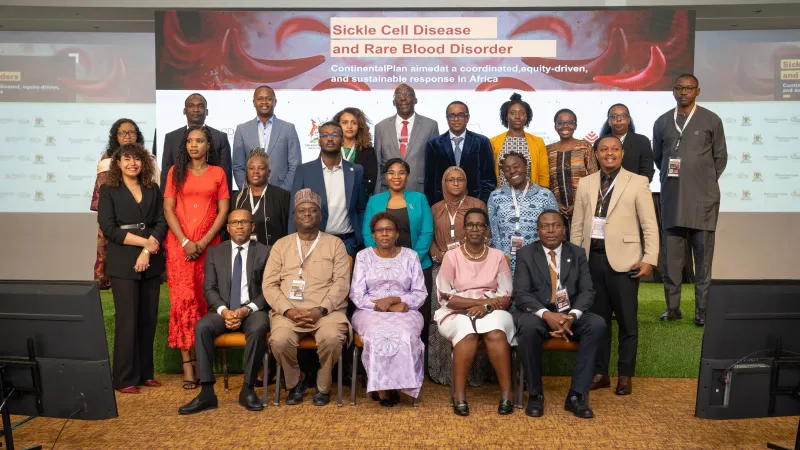





Uganda has officially launched the Africa CDC Continental Plan for Sickle Cell Disease (SCD) and other rare blood disorders, marking a major step in strengthening Africa’s response to one of the continent’s most pressing public health challenges.
The launch took place during the Technical Validation Workshop officiated by the Minister for Health, Dr. Jane Ruth Aceng.
According to the Ministry of Health, the continental plan was developed with support from Africa CDC through a rigorous process aimed at providing direction for African countries on the prevention and control of Sickle Cell Disease and other rare blood disorders.
In her remarks, Permanent Secretary Dr. Diana Atwine called on African countries to prioritize SCD by allocating budgets toward prevention, treatment, and care services.
The Director General Health Services, Prof. Olaro Charles, noted that the continental plan will help close gaps at both continental and community levels. The Ministry of Health added that the plan is built on data and is intended at “saving lives.”
Dr. Olaro , informed members that the national trait prevalence of Sickle Cell Disease (SCD) stands at 13%, with approximately 20,000 babies born annually with SCD in Uganda. He further highlighted that Uganda’s efforts in combating Sickle Cell Disease continue to provide valuable benchmarks for the continent’s response and strategic interventions.
Dr. Olaro called upon Member States and stakeholders to prioritize sustainability in SCD programming, improve access to Hydroxyurea and other essential commodities, and integrate Sickle Cell Disease services into national health insurance schemes and broader healthcare systems.
“These commitments remain critical in strengthening equitable healthcare access and improving the quality of life for persons living with Sickle Cell Disease across Africa”, Dr. olaro said.
Dr. Aceng described the initiative as a unified continental commitment to tackling Sickle Cell Disease.
“This morning, I officiated the Technical Validation and Launch Workshop of the Continental Plan for Sickle Cell Disease and other Rare Blood Disorders. This Continental Plan developed with support from Africa CDC is a commitment to a unified response to Sickle Cell Disease,” Dr. Aceng said.
The Health Minister also highlighted Uganda’s ongoing efforts to strengthen SCD prevention and treatment services across the country.
“Uganda is accelerating the fight against Sickle Cell Disease (SCD); we launched and are now focusing on screening all newborns for SCD. Uganda also launched locally manufacturers test kits that are very sensitive in newborns,” she said.
Dr. Mohammed AbdulAziz, Head of the Non-Communicable Diseases, Injuries and Mental Health Division at Africa CDC, called upon Member States and partners to strengthen political commitment towards combating Sickle Cell Disease through:
• Improved access to essential commodities and healthcare services
• Workforce development and capacity strengthening
• Country ownership and accountability
• Enhanced coordination among stakeholders and partners
“This collective commitment is critical to building resilient health systems and ensuring no one affected by Sickle Cell Disease is left behind”, Dr. AbdulAziz said.
Uganda has also been implementing the Strengthening Care Access and Linkage for SCD (SCALE) programme in partnership with Texas Children’s Global HOPE. The programme integrates SCD care into primary healthcare systems while training specialist nurses and paediatric haematologists.
“Through the Strengthening Care Access and Linkage for SCD (SCALE) programme, implemented with Texas Children's Global HOPE, Uganda has been a proud pilot country, integrating SCD care into primary healthcare systems and training specialist nurses and paediatric haematologists,” Dr. Aceng stated.
The minister further revealed that more than 2,000 patients in Uganda and across the East African region have accessed hydroxyurea through collaborative clinical partnerships.
“Today, over 2,000 patients across Uganda and the East Africa region have accessed hydroxyurea through collaborative clinical partnerships. We have prospects of starting to manufacture hydroxyurea in-country,” she said.
Dr. Aceng said Uganda’s experience demonstrates the importance of early detection, comprehensive care, and community engagement in saving lives from Sickle Cell Disease.







Sunrise reporter
Leave a Comment
Your email address will not be published.