

Uganda’s oil and gas sector has attracted more than US$14 billion in investments and employed 18,958 Ugandans, as government, civil society organisations and petroleum companies call for greater local participation, environmental protection and lasting economic benefits ahead of the country’s first oil production.
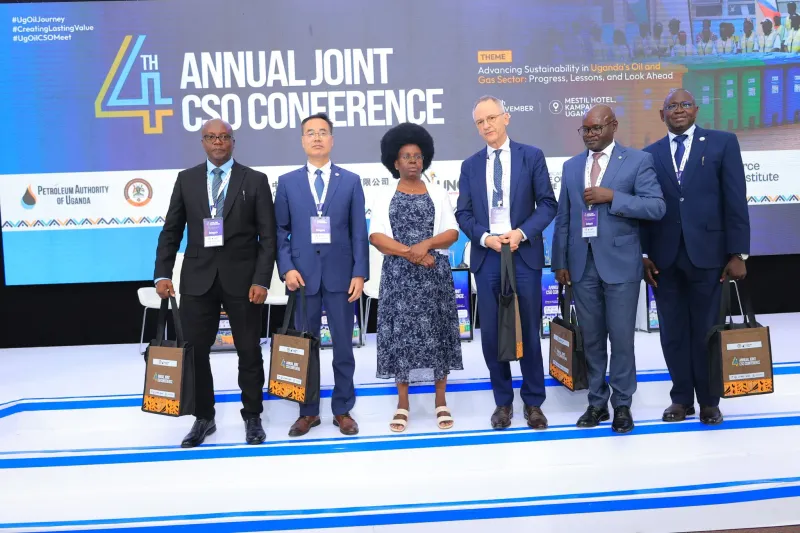
The figures were announced by the Acting Executive Director of the Petroleum Authority of Uganda (PAU), Michael Otonga Ochan, during the Fourth Annual Joint Conference for Civil Society Organisations (CSOs) and Non-Governmental Organisations (NGOs) working in Uganda’s oil and gas sector, held at Mestil Hotel in Kampala on Wednesday.
Ochan revealed that by June 30, 2026, the sector had employed 22,234 people, of whom 18,958 were Ugandans, representing 85 per cent of the total workforce.
He also reported that the cumulative value of approved Tier One contracts had reached US$7.6 billion, with Ugandan companies securing contracts worth US$2.3 billion, equivalent to approximately 30 per cent.
According to Ochan, the figures demonstrate the contribution of petroleum investments to employment creation, local enterprise development, skills transfer and increased national participation in the industry.
He said Uganda had registered significant progress since the announcement of the Final Investment Decision (FID) in February 2022, with investments supporting the development of major petroleum infrastructure and stimulating economic activity across several sectors.
Ochan noted that PAU had spent the past 11 years establishing regulatory frameworks, strengthening technical monitoring and compliance systems, and overseeing the transition from exploration to the development and construction of major petroleum infrastructure.
As Uganda moves towards petroleum production and commercialisation, he said the Authority's regulatory responsibilities would become even more critical.
“As Uganda advances into the production and commercialisation phase of its petroleum industry, the Authority’s regulatory role will become even more critical. Our focus will be on ensuring safe and efficient operations, maximising recovery of the country’s petroleum resources, safeguarding the environment, and ensuring that the benefits generated contribute meaningfully to national development,” Ochan said.
He added that Uganda's success would ultimately be measured by the extent to which its petroleum resources create lasting value for present and future generations.
The Minister of Energy and Mineral Development, Dr Monica Musenero, challenged stakeholders to look beyond oil extraction and focus on converting petroleum resources into productive industries, stronger domestic enterprises and national wealth.
Speaking while officially opening the conference, Musenero said sustainability required continuous innovation and adaptation rather than simply maintaining existing systems.
She challenged stakeholders to address three fundamental questions concerning Uganda's petroleum development: where the money is, where the industries are and where the energy needed to power development will come from.
The Minister emphasised that petroleum development must contribute to employment, industrialisation, energy access, improved livelihoods and the financing of public services.
She also stressed the importance of strengthening local capacity, technology transfer and investment in domestic industries to ensure Ugandans participate meaningfully in the opportunities created by the sector.
In a particularly strong message on economic transformation, Musenero said the existence of petroleum resources does not automatically translate into national wealth.
“As I emphasised in my recent address at the Uganda Media Centre, the existence of oil does not automatically translate into national wealth. Our responsibility is to convert petroleum resources, investments, revenues and acquired knowledge into lasting productive capabilities, industries and national wealth,” she said.
She described this as the process of moving from wells to wealth, arguing that Uganda must build institutions, competitive domestic enterprises and a skilled workforce capable of sustaining economic activity beyond the petroleum production period.
Musenero also recognised the important role played by civil society organisations and NGOs in promoting transparency, accountability and public participation in the oil and gas sector.
She said civil society contributes through policy research, advocacy, community engagement, public education and independent monitoring, including efforts to protect human rights and strengthen accountability.
“Government recognises and appreciates these contributions and encourages continued constructive engagement,” she said.
The Minister further called for an integrated approach to sustainability that balances environmental protection, social responsibility and economic development.
She said petroleum operations must comply with environmental standards, protect biodiversity and water resources, and minimise adverse impacts on ecosystems and communities.
She also emphasised the need to respect the rights, dignity and livelihoods of project-affected persons, workers and host communities, with particular attention to fair compensation, safe working conditions, gender inclusion and meaningful community participation.
Musenero noted that the four annual civil society dialogues had generated practical recommendations on coordination, capacity building, youth participation and stakeholder collaboration.
Meanwhile, the Chairperson of the Civil Society Coalition on Oil and Gas Uganda (CSCO Uganda), Bashir Twesigye, welcomed the government's consideration of lifting the suspension on some civil society organisations.
Twesigye said the development offered an opportunity for government, civil society and the private sector to strengthen cooperation and focus on their shared development objectives.
“We are encouraged by the Government's consideration of lifting the suspension on some civil society organisations. It is a reminder that government, civil society, and the private sector are not adversaries but partners in development,” he said.
He called for dialogue and mutual respect, adding that constructive engagement would help stakeholders move beyond their differences and work together for the benefit of Ugandans.
Twesigye also challenged claims that civil society organisations were responsible for delays in achieving First Oil, describing such allegations as unsupported by facts.
“It is inaccurate to suggest that civil society is responsible for the delay in achieving First Oil. Such claims are not supported by the facts,” he said.
He added that government, industry and civil society shared a common interest in ensuring Uganda's petroleum resources were developed responsibly and delivered lasting benefits to the country.
The debate on sustainability also featured prominently in contributions from the Uganda National Oil Company (UNOC), with Chief Corporate Affairs Officer Tony Otoa arguing that Africa's energy transition must reflect the continent's development realities.
Otoa highlighted the continued dependence of many African households on traditional cooking fuels, including firewood, and called for responsible resource development to expand access to affordable cleaner cooking energy.
“Africa's energy transition must reflect Africa's realities. Millions of people, including my own mother in Lira, still depend on firewood for daily cooking. By developing our resources responsibly, we can expand access to affordable clean cooking gas, improve health outcomes, protect the environment, and transform lives across our communities,” Otoa said.
He also urged stakeholders to examine the information and narratives surrounding Uganda's oil and gas industry carefully, warning against one-sided accounts.
He said the country's petroleum story should be presented fairly and objectively, taking into consideration the interests of Africa and the benefits that responsible resource development could deliver to Ugandans.
On the industry side, TotalEnergies Uganda General Manager Philippe Groueix emphasised the importance of ensuring that petroleum development positively affects communities within operational areas.
“We cannot be happy when people living within our operational areas are not happy. Our mission is to ensure that communities are positively impacted by our activities. I firmly believe that TotalEnergies Uganda has transformed lives and created lasting positive change,” Groueix said during his opening remarks.
CNOOC Uganda Limited also highlighted environmental protection and cleaner energy initiatives under its Kingfisher Development Area Project in the Albertine Graben.
The company's Acting President, Hu Weijie, described the Kingfisher project as an example of how petroleum resources can be developed while protecting the environment and supporting neighbouring communities.
He said the project had integrated sustainability into its development through Environmental and Social Impact Assessments, biodiversity conservation measures and continuous environmental monitoring.
One of the notable interventions has been the transition from diesel-powered electricity generation to hydropower.
Hu disclosed that the initiative had eliminated the consumption of more than 1,400 litres of diesel every day, reducing greenhouse gas emissions, fuel-related waste and operational costs.
The transition has also extended access to cleaner and more reliable electricity to neighbouring communities, including the Buhuka Water Supply Scheme.
Other interventions highlighted by CNOOC include LPG recovery and power generation, environmental restoration, tree-planting programmes, improved waste management and food waste recycling at workers' camps.
The company has also deployed technologies such as the LR8001 Modified Rig as part of efforts to improve operational efficiency and environmental responsibility.
Hu said the experience demonstrated that economic development and environmental protection could be pursued together through innovation, cleaner technologies and responsible project management.
He identified meaningful stakeholder engagement, sustainability integration at every stage of project implementation and partnerships among government, industry, communities, civil society and development partners as important lessons from the Kingfisher experience.
He nevertheless acknowledged that challenges remained in balancing industrial development with environmental conservation, managing community expectations, strengthening local capacity, safeguarding human rights and ensuring equitable distribution of petroleum sector benefits.
The East African Crude Oil Pipeline (EACOP) also presented its contribution to employment, skills development, education and community empowerment in Uganda and Tanzania.
The pipeline project's Deputy Managing Director, J.B. Habumugisha, said sustainability extended beyond constructing infrastructure connecting the two countries to creating lasting benefits for communities along the project corridor.
He said EACOP's Social Economic Investment programmes were guided by the principle of shared value, ensuring that communities were not merely observers of development but active participants and beneficiaries.
Habumugisha reported that EACOP had conducted 43 Industrial Enhancement Centre sessions aimed at strengthening small and medium-sized enterprises (SMEs), alongside 44 Train-the-Trainer programmes targeting university lecturers.
The initiatives had supported more than 132 beneficiaries through international and local internships and graduate trainee programmes, while over 4,000 Ugandans had been employed at the peak of construction.
In the education sector, EACOP had provided more than 40 scholarships to financially disadvantaged students pursuing engineering programmes at Makerere University and Kyambogo University.
The project had also signed Memoranda of Understanding with Makerere University, Kyambogo University, Uganda Industrial Research Institute, Uganda Petroleum Institute Kigumba and Nakawa Technical Vocational Institute.
Habumugisha further disclosed that more than 240,000 training hours had been delivered through certified and skills development programmes covering specialised technical areas, including pipe welding, pipe cold bending, excavation, non-destructive and destructive testing, side-boom operation, defensive driving and occupational health and safety.
He said the programmes were intended to strengthen local technical competencies and build a skilled workforce for the wider petroleum industry.
According to Habumugisha, EACOP's community investment priorities include youth opportunities, access to water, community health and safety, sustainable energy and environmental stewardship.
He emphasised that the impact of sustainability programmes should be assessed through their long-term contribution to household livelihoods, youth employability, local enterprise development and opportunities for women and vulnerable communities.
The discussions also highlighted the need for transparency, accountability, effective regulation, environmental conservation, climate resilience and economic diversification as Uganda prepares to benefit from its petroleum resources.
Ochan identified economic sustainability, environmental and social sustainability, and governance and accountability as three interconnected priorities for the sector.
Citing the Uganda SDG Progress Assessment 2026, he noted that the country's Sustainable Development Goals Index had improved from 51.5 in 2015 to 55.84 in 2025, although only 28 per cent of assessed targets were on track.
He called for petroleum resources to accelerate socio-economic transformation, industrialisation, energy access and improved livelihoods while safeguarding the environment.
The Fourth Annual Joint Conference, held under the theme “Advancing Sustainability in Uganda's Oil and Gas Sector: Progress, Lessons and Look Ahead,” brought together government officials, licensed oil companies, civil society organisations, development partners and other stakeholders to assess progress and strengthen collaboration.
As Uganda approaches first oil, the discussions underscored a common message, the long-term success of the petroleum industry will depend not only on investment, infrastructure and production, but also on its ability to create productive industries, empower Ugandans, protect communities and the environment, and build lasting national wealth.




Sunrise reporter
Leave a Comment
Your email address will not be published.