





Elections
Presidential and Parliamentary Ballot Papers Arrive as Electoral Commission Steps Up Election Preparations
The Electoral Commission on Wednesday received presidential ballot papers ahead of the forthcoming general elections, in which eight candidates are competing for the country’s top political office.
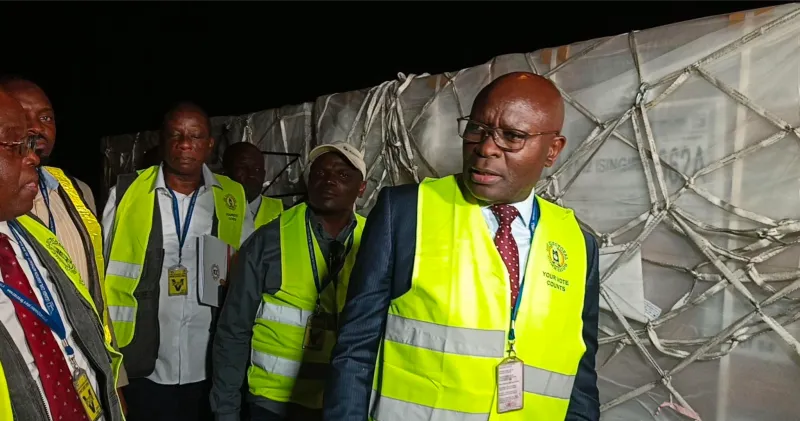
The sensitive election materials arrived at Entebbe International Airport, where the Chairperson of the Electoral Commission, Justice Simon Byabakama, led a team of commissioners, senior technical staff, and representatives of political parties to oversee the delivery.
Justice Byabakama confirmed that the consignment consisted of 193 pallets of presidential ballot papers printed by Dubai-based Al Ghurair Printing & Publishing Company. The shipment was transported aboard a privately chartered cargo aircraft operated by Air Atlanta Icelandic for the Network Aviation Group. The aircraft, registration TF-AKE, landed at about 9:00pm, and offloading began immediately upon arrival.
The unloading exercise continued throughout the night under tight security. The ballot papers were transferred onto trucks that had arrived earlier and were escorted by a heavily armed convoy of Counter Terrorism police officers to ensure maximum protection during transportation.
Addressing journalists at the airport, Justice Byabakama assured the public that the ballot papers are fully secure and not susceptible to interference. He emphasized that all necessary safeguards have been put in place to protect the integrity of the electoral materials.
The Electoral Commission Chairperson explained that the ballot papers were systematically organized and clearly labeled by district to ease handling, storage, and nationwide distribution. Reporters observed sealed boxes marked for various districts, including Wakiso, Isingiro, Kiboga, Mayuge, and Kasese.
Justice Byabakama said the Commission printed slightly more ballot papers than the total number of registered voters to cater for cases where a voter accidentally or intentionally spoils a ballot paper, as provided for under the law.
A second consignment of ballot papers for directly elected members of Parliament parliamentary ballot papers has already arrived, while the final shipment for the parliamentary elections is expected on December 26, 2025.
After airport clearance, the ballot papers will be transported to secure Electoral Commission warehouses, where they will be stored under strict security until they are distributed across the country ahead of polling day.
In line with transparency and accountability principles, the delivery process was witnessed by representatives of presidential candidates, political parties, accredited election observers, and members of the media. Justice Byabakama noted that all political parties were invited to observe the exercise as part of efforts to build public confidence in the electoral process.
When asked about the cost of printing and transporting the ballot papers, Justice Byabakama said the figures were not immediately available, explaining that the Commission’s accounting officer was not present at the time. He assured the public that the cost details would be communicated later and emphasized that the information is not classified.
Justice Byabakama also used the opportunity to condemn election-related violence and urged all political actors and citizens to maintain peace throughout the electoral period. He called on stakeholders to act within the law and to demonstrate civility, tolerance, and respect for one another to ensure a peaceful and credible election process.
He concluded by appealing to Ugandans to view the elections as an opportunity for democratic expression rather than a source of conflict, emphasizing that peace and stability are essential for the success of the national electoral exercise.





Sunrise reporter
Leave a Comment
Your email address will not be published.