
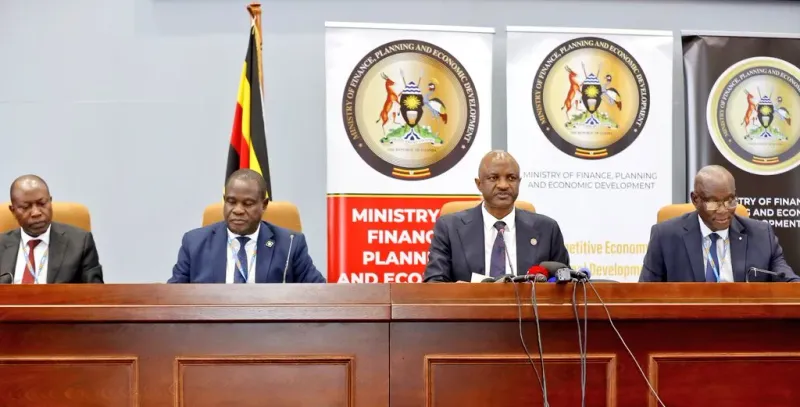



Uganda’s Ministry of Finance has highlighted fiscal discipline in the release of the Fourth Quarter (Q4) budget for FY 2025/26, reflecting the government’s commitment to responsible spending while supporting key growth sectors.
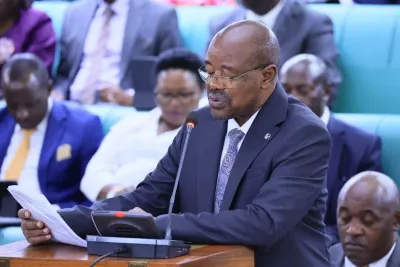
During the briefing, PSST Dr. Ramathan Ggoobi explained that the Q4 expenditure limits are guided by the fiscal consolidation agenda, which emphasizes maintaining macroeconomic stability and ensuring that government resources are used efficiently.
The total release for Quarter Four for FY 2025/26 amounts to Shs 17.444 trillion. This brings the cumulative total release for FY2025/26 to Shs 77.001 trillion which is 106.4% of the approved budget and 95.1% of the revised budget.
Priority Growth Sectors
The Q4 budget ensures funding for Uganda’s high-priority sectors under the government’s ATMS strategy:
- Agro-industrialisation: Expanding agricultural production, processing, and exports. Agro-industrialisation (A) Shs 314.9 billion for agro-industrial research and innovation, especially fast-tracking the rollout of the anti-tick vaccine, operations and critical programme interventions.
- Tourism Development (T) : Shs 48.6 billion for tourism development and promotion interventions, including the “Explore Uganda" drive, and development of Uganda Martyrs Shrine, Namugongo.
- Mineral-Based Industrial Development including oil and gas (M) : Shs 24.3 billion to the Petroleum Authority of Uganda (PAU) for continuing the implementation of interventions towards fast- tracking first oil.
- Science, Technology and Innovation including ICT and the creative industry - Shs 184.5 billion for expanding internet connectivity and digitisation of the economy.
Investment in Growth Enablers
In addition to the ATMS sectors, the budget provides for key enablers of growth, including:
- Security: Ensuring safety for citizens and businesses.
- Infrastructure: Roads, energy, and transport systems that support economic activity.
- Human Capital Development: Health, education, and skills development programs to improve workforce productivity.
These investments aim to sustain the government’s broader economic growth agenda.
Operational Expenditure
The Q4 budget also guarantees minimum operational funding for all Ministries, Departments, Agencies, and Local Governments, ensuring that essential government functions continue without disruption.
Macroeconomic Stability
Dr. Ggoobi noted that Uganda continues to experience macro stability, with:
- A strong Uganda shilling, reflecting prudent financial management.
- Annual headline inflation averaging 3.3%, keeping prices stable.
This demonstrates that fiscal discipline is being implemented while supporting the economy and key development priorities.
Economic Growth Context
While the Q4 briefing focused on spending priorities and fiscal discipline, it also highlighted the strong overall performance of the economy. PSST Dr. Ggoobi says preliminary estimates show that the economy expanded by 8.5 percent in the second quarter of FY 2025/26, from 5.4 percent recorded in the same period during FY 2024/25.
"The average economic growth for the first half of FY 2025/26, therefore, increased to 6.7 percent from 5.8 percent during the same period last year," said Dr. Ggoobi.
He said this strong performance was primarily driven by robust aggregate demand, investment and exports, reflected by increased production in the industrial, services, agriculture, forestry and fishing sectors of the economy.
The PSST said GDP growth is expected to accelerate from 6.6 percent to 7.0 percent this FY 2025/26, up from 6.3 percent in FY 2024/25.
GDP is projected to reach USD 68.4 billion (Shs 251.4 trillion) by June 2026, equivalent to USD 194.2 billion in Purchasing power parity (PPP) terms.
GDP per capita is expected at USD 1,399 (Shs 5.03 million).
Transparency and Accountability
The Ministry of Finance continues to promote budget transparency by informing the public about funds released for service delivery, priority sectors and operational expenditures, and policies affecting the utilization of funds.
These initiatives are aimed at providing information to all stakeholders to facilitate monitoring & accountability.
Key Takeaways
- Uganda’s Q4 budget emphasizes fiscal discipline while sustaining strategic investments.
- Priority sectors include Agro-industrialisation, Tourism, Minerals, and Science & Technology (ATMS).
- The budget supports macro stability, low inflation, and a strong Uganda shilling.





Sunrise reporter
Leave a Comment
Your email address will not be published.