




The Government of Uganda has unveiled seven strategic shifts that will guide the formulation and implementation of the Financial Year 2027/28 national budget, with emphasis on domestic revenue mobilisation, private investment, job creation, exports, household incomes and economic transformation.
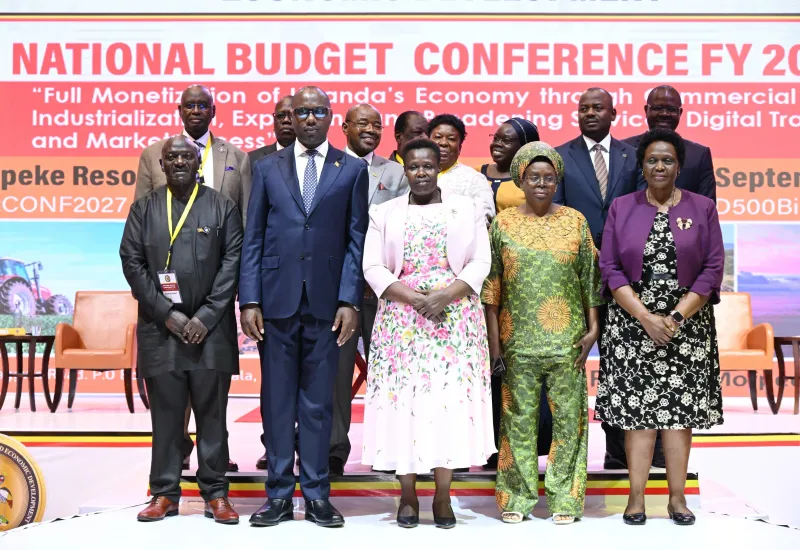
The priorities were outlined during the National Budget Conference for FY 2027/28 held at Speke Resort Munyonyo, bringing together representatives from central and local government, the private sector, civil society, academia and other stakeholders.
The conference was held under the theme “Full Monetization of Uganda’s Economy through Commercial Agriculture, Industrialization, Expanding and Broadening Services, Digital Transformation and Market Access.”
The consultations form part of the implementation of the Fourth National Development Plan (NDP IV) and the Tenfold Growth Strategy, under which Uganda is targeting a USD 500 billion economy.
Minister of State for Finance, Planning and Economic Development Henry Musasizi said the FY 2027/28 Budget Strategy is designed to accelerate implementation of the Agricultural Transformation and Market Strategy (ATMS) and its enablers while strengthening fiscal discipline and accountability.
The first shift is revenue-led fiscal consolidation, placing domestic revenue mobilisation at the centre of budget formulation.
According to the government, this will involve broadening the tax base through data and technology, reducing revenue leakages, improving compliance and strengthening complementary sources of financing, including non-tax revenue.
The government says the resources mobilised will be prioritised towards ATMS, its enablers and essential public services.
The second shift is prudent management of oil revenues. The government says oil revenues will be managed transparently and sustainably in accordance with the Public Finance Management Act as Uganda moves towards oil production.
The third shift is mobilising private capital for ATMS. The government intends to use innovative financing mechanisms, strengthen public-private partnerships, improve the business environment and attract more foreign direct investment.
The fourth shift is the accelerated implementation of the Tenfold Growth Strategy through effective implementation of ATMS and its enablers. Government says this will require stronger coordination among public institutions, deeper partnerships with the private sector and consistency between policies and implementation.
The fifth shift puts jobs, exports and household incomes at the centre of the budget.
Government says economic growth must increasingly translate into structural transformation by making the economy more export-oriented, creating productive employment and ensuring that growth remains fiscally sustainable.
The sixth shift focuses on strengthening wealth creation programmes, including the Parish Development Model (PDM), Emyooga and the Presidential Skilling and Industrial Hubs.
The government says these programmes will be strengthened to increase production, employment and household incomes and deepen the monetisation of Uganda's economy.
The seventh shift is stronger budget discipline, credibility and accountability.
The proposed reforms will focus on allocative efficiency, internal controls, audit systems, procurement and accountability for results, with the aim of ensuring that public resources generate measurable economic and social returns.
Vice President Jessica Alupo officiated at the National Budget Conference and delivered a message from President Yoweri Kaguta Museveni.
In the message, Museveni said Uganda had built a strong economic foundation but needed to intensify efforts to fully monetise the economy by moving more households from subsistence production into commercial and market-oriented activity.
The President highlighted production, productivity, value addition, market access and household incomes as key areas in Uganda's pursuit of the Tenfold Growth Strategy.
According to the figures presented at the conference, Uganda's GDP has reached Shs250.4 trillion, equivalent to USD69.35 billion, in nominal terms.
Museveni also said Uganda had surpassed the lower-middle-income threshold, with gross national income per capita reaching USD1,389, against the cited threshold of USD1,136.
The President pointed to sustained economic growth, exports, expanded access to health, education and social services, national infrastructure and the foundation for industrialisation and manufacturing as areas of progress.
Museveni identified three major constraints that Uganda must continue addressing: dependence on rainfall for agriculture, limited value addition to commodities and inadequate access to markets.
He called for increased investment in irrigation to reduce dependence on rainfall and greater efforts to add value to Uganda's commodities.
The government also wants to increase domestic revenue mobilisation. Museveni called for the tax-to-GDP ratio to rise from about 14 percent to about 25 percent, including through efforts to close revenue leakages.
The President said the overall focus would remain on the full monetisation of Uganda's economy through commercial agriculture driven by irrigation, industrialisation for value addition, expanded access to critical services and improved market access.
The FY 2027/28 Budget Strategy places domestic revenue and private capital at the centre of financing Uganda's economic transformation agenda.
Government says budget interventions should contribute to higher production and productivity, increased exports, private investment, job creation and higher household incomes.
The strategy also emphasises expanded market access and greater participation in commercial economic activity as Uganda pursues its USD500 billion economy ambition.
During the conference, Finance Minister Henry Musasizi said directing more resources towards ATMS and its enablers was strategically more important to the government's Tenfold Growth Agenda than additional financing for newly created cities.
He was responding to participants who had raised the issue of prioritising funding for new cities in the FY 2027/28 budget.
Musasizi also called for greater budget discipline to prevent the accumulation of domestic arrears and said there is a plan to clear existing arrears.
On salary enhancement proposals, Minister of Public Service Gen. Katumba Wamala said requests, particularly from local governments, would be studied.
However, he cautioned that the government would not use oil revenue to finance salary enhancements and called for continued budget discipline and accountability.
Stakeholders participating in the National Budget Conference submitted proposals on areas they want addressed in the FY 2027/28 budget.
The submissions included calls for improved management of tax exemptions and incentives, stronger tax dispute-resolution mechanisms, better debt management and accountability, improved public investment management and enhanced digital tax administration.
Other issues raised included clearance of domestic arrears, funding for roads and remuneration of local government leaders, including district chairpersons, mayors and their deputies.
The consultations are intended to inform the formulation of Uganda's FY 2027/28 national budget.
The FY 2027/28 Budget Strategy ultimately links fiscal policy to Uganda's wider economic transformation ambitions.
The government says commercial agriculture, industrialisation, expanded services, digital transformation, market access, value addition, private investment and stronger revenue mobilisation will be central to moving more households into the money economy.
With GDP reported at Shs250.4 trillion and the government targeting a USD500 billion economy, the FY 2027/28 budget is being positioned as an important instrument for translating economic growth into jobs, exports, higher household incomes and broader economic participation.
The government says the overarching objective is to build a more productive, competitive and higher-income Ugandan economy while maintaining fiscal discipline and accountability.







Sunrise reporter
Leave a Comment
Your email address will not be published.