
President Yoweri Kaguta Museveni has ordered renewed action against corruption, absenteeism and medicine shortages in Uganda’s public health facilities, warning that non-performing government health workers could be replaced by younger qualified professionals.
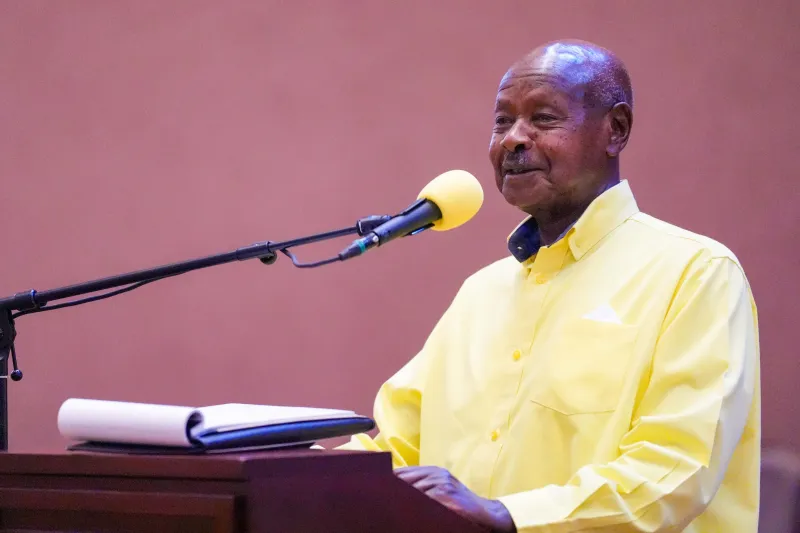
Museveni made the remarks on Friday, while addressing members of the National Resistance Movement (NRM) Parliamentary Caucus at Speke Resort Munyonyo in Kampala.
The President, who is also the NRM National Chairman, said his recent countrywide campaigns had enabled him to identify concerns raised by citizens that require urgent government attention.
He highlighted health service delivery, corruption, the Parish Development Model (PDM), crime, local government staffing, cancer and other non-communicable diseases among the issues requiring action by the government and Parliament.
Museveni said the shortage of medicines in public health facilities was one of the major concerns raised by citizens.
He questioned why some government health centres reportedly have no medicines while patients are allegedly directed to private drug shops and pharmacies to purchase them.
The President said the government needed to establish whether the shortages were caused by inadequate supplies or possible theft.
He said the matter would be discussed by Cabinet and pledged to personally follow up on reports concerning medicine shortages and possible diversion of drugs.
“In health facilities you find that there are no drugs, and people are being told to go and buy from outside in drug shops and pharmacies. This one must stop. I’m going to check,” Museveni said.
The President also expressed concern about absenteeism among health workers, including doctors expected to serve in government facilities.
Museveni said Uganda has qualified young medical professionals who could be recruited to fill positions occupied by workers who do not report for duty.
He warned that the government would eventually remove workers who are unwilling to perform their duties and replace them with younger professionals.
“We shall reach a point and chase away those who don’t want to work and replace them with young ones,” he said.
Museveni said improving health service delivery was important not only for individual families but also for the country's productivity.
“The last time I was sick with malaria was in the bush. Sickness is lost contribution time,” he said.
The President also raised concern over the increasing burden of cancer and diabetes in Uganda.
He said the government should investigate the causes of the diseases and strengthen preventive measures.
Museveni noted that Uganda had made progress in controlling infectious diseases such as Guinea worm, measles and polio, but said non-communicable diseases were becoming an increasing challenge.
He said he frequently receives requests from Ugandans seeking assistance to travel to India for cancer treatment.
“People are contacting me to go to India for treatment. What is causing the cancer? Why are cancers so much now? Why is it so rampant?” he asked.
Museveni also recalled his previous concerns about a possible relationship between fungal contamination and liver cancer and said he had earlier taken measures concerning shelled groundnuts.
“I’m going to make proposals to the Cabinet because cancers and diabetes are becoming too much,” he said.
On corruption, Museveni commended some government officials whom he said were taking action against corruption at the local level.
He specifically mentioned Minister for Local Government Balaam Barugahara and his junior, Justine Nameere.
The President linked some of the resentment among citizens at the local level to allegations that PDM funds were being taken or diverted by local leaders and other officials.
He urged MPs to use their positions to listen to citizens, expose corruption and speak out against wrongdoing in their constituencies.
Museveni told legislators that remaining silent about corruption would not help the government or the public.
“If you think that keeping quiet is good, it will not help at all. I would really like to mobilize you people to fight corruption without fear, and you will be very popular among the population,” he said.
Museveni directed Prime Minister Robinah Nabbanja to instruct Minister Balaam Barugahara to investigate allegations of theft and corruption involving PDM funds in several areas.
He mentioned Pakwach, Maracha, Iganga and Buwambo among the places where allegations of PDM fund theft or misuse had been raised.
The President recalled that his campaign visit to Maracha had effectively turned into a discussion about PDM.
“In Maracha, when I went to campaign, the rally turned into a PDM meeting,” he said.
However, Museveni praised Kasese District, saying he had received reports that PDM was performing well there.
“Where I heard PDM was doing well was in Kasese,” he said.
The President described PDM as a potentially transformative programme for households if properly implemented and urged MPs and local leaders to monitor its implementation and expose cases of alleged diversion, theft and corruption.
The President also raised concerns over alleged corruption in the recruitment of local government workers.
He said he had received reports that some government jobs were allegedly being sold to applicants.
Museveni cited information he said he had received from Kibale, where a government job was allegedly being offered for Shs10 million.
“Then you come to the local government. The selling of local government jobs. They told me in Kibale a government job was going for 10 million shillings,” he said.
He urged MPs to monitor recruitment processes and ensure that government employment is based on merit rather than an applicant's ability to pay.
Museveni also criticised what he described as excessive attention to creating new districts, cities and political positions at the expense of programmes aimed at increasing household incomes.
He said government should concentrate on strategic development priorities, particularly irrigation, which he described as a “lifesaver” in the fight against poverty.
The President cited a proposal to divide Ntungamo District into three districts, saying that, according to his account, the move was partly motivated by the desire of some individuals to create additional political positions.
“For example, they wanted to split Ntungamo into three districts because some people wanted to become women members of Parliament,” he said.
Museveni urged MPs to focus on what he described as Uganda's core development priorities, including defence and security, roads, railway infrastructure, schools and irrigation.
Museveni further called on local government leaders and MPs to work closely with security agencies to combat crime in their respective areas.
He said criminality should not be allowed to undermine development and called for cooperation between political leaders and security institutions.
Following Museveni's address, the NRM Parliamentary Caucus adopted 11 resolutions outlining its commitment to supporting government programmes and strengthening discipline within the ruling party.
The resolutions were presented by Government Chief Whip Dr Jane Ruth Aceng.
The caucus resolved to support strategic government programmes in priority areas, including defence, security, railways, roads, irrigation, health and education.
It also resolved to continue supporting the fight against corruption across all sectors of government as part of efforts to promote Uganda's socio-economic transformation.
On elections, the caucus resolved to support discipline and integrity in electoral processes within the party and nationally and to desist from electoral malpractice.
The legislators also pledged continued support for ongoing and forthcoming local council and women's council elections.
The caucus reaffirmed its commitment to financial contributions agreed upon by the Central Executive Committee. Under the resolution, MPs are expected to contribute Shs250,000 monthly, comprising Shs150,000 to the NRM Party and Shs100,000 to the NRM Parliamentary Caucus, beginning June 2026.
The caucus also welcomed independent MPs who support the NRM into its ranks.
On PDM, the legislators resolved to continue supporting the programme, increase its uptake and visibility, and strengthen follow-up in cases involving alleged diversion, theft and corruption.
The caucus further resolved to study the issue of school fees in public schools and make proposals on how government can address the challenge.
Other resolutions included supporting value addition, internal markets and regional integration.
The final resolution was to support the candidature of Ambassador Olara Otunnu for the position of Secretary-General of the United Nations.
Earlier, Dr Aceng thanked members of the NRM Parliamentary Caucus for what she described as their commitment, discipline and patriotism since the beginning of the 12th Parliament.
She also thanked NRM legislators and independent MPs aligned with the caucus for supporting two Bills that Museveni had returned to Parliament for reconsideration: the Tax Amendment Bill and the Excise Duty Bill.
“By supporting the guidance you gave, the caucus once again demonstrated its commitment to advancing government business and protecting the interests of our country under your able leadership,” she told Museveni.
Aceng also commended MPs for supporting a motion authorising the deployment of the Uganda People's Defence Forces to the Gaza Strip for a peacekeeping mission.
She said the decision demonstrated that MPs could put national interests above partisan considerations when making critical decisions.
“I also wish to thank members for supporting the motion authorising the deployment of the Uganda People's Defense Forces to the Gaza Strip for a peacekeeping mission at yesterday's sitting,” she said.
Aceng said Uganda remained proud of the contribution of its armed forces to regional and international peace and security.

Sunrise reporter
Leave a Comment
Your email address will not be published.