
News
Bishop Ashley Null Hails Africa’s Role in Anglicanism as Uganda Marks Janani Luwum Day in Kitgum
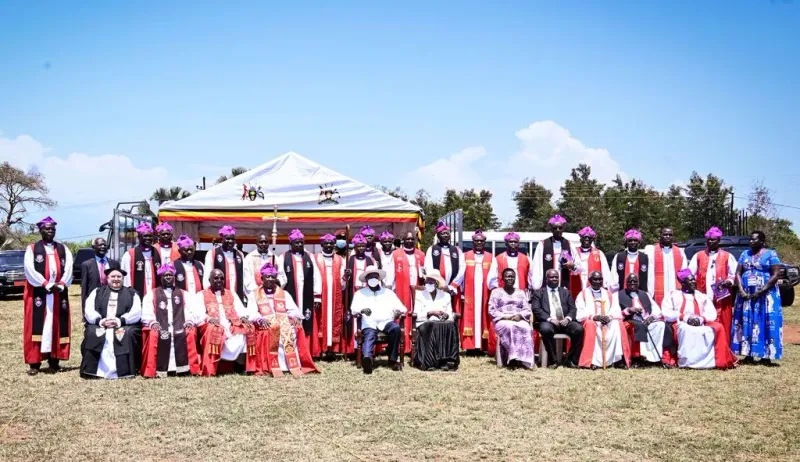
Thousands of believers, church leaders and government officials on Sunday gathered in Mucwini Sub-county, Kitgum District, to commemorate the 49th anniversary of the martyrdom of Archbishop Janani Luwum, under the theme: “Anchored in Christ for Unity, Stability and Peace.”
The commemoration, popularly known as Janani Luwum Day, honoured the legacy of the former Archbishop of the Church of Uganda who was killed on February 16, 1977, during the regime of former president Idi Amin.
Bishop Null: Africa Shaped Anglican Theology
Preaching at the event, Rt Rev Ashley Null, the second Anglican Bishop of North Africa, said Africa played a foundational role in shaping Anglican theology, arguing that the early English reformers drew heavily from African church fathers.
“The English reformers looked to Africa for their theology. Africa shaped Anglicanism. To be an African Anglican is to be African twice,” Bishop Null told worshippers.
He urged African Christians to take pride in their heritage, dismissing the narrative that missionaries brought Christianity to Africa.
“They did not bring Christianity to Africa; they brought it back home,” he said.
Bishop Null said the Christian church in Africa was founded through sacrifice and suffering, noting that Archbishop Janani Luwum’s death remains a symbol of faithfulness to the gospel.
“The church in Africa was birthed in blood. The church in Uganda was birthed in blood,” he said.
Remembering Luwum’s Courage Against Amin
Reflecting on Uganda’s dark past under Idi Amin, Bishop Null described the period as one of terror marked by torture, killings and arbitrary arrests, warning that violence can erupt even when society appears calm.
He said Archbishop Luwum, remembered as a peacemaker and unifier, was compelled to speak out against injustice and the breakdown of society.
Null recalled that during his Christmas Day radio address, Luwum condemned hatred, greed and unforgiveness, calling on Ugandans to pursue peace.
However, the sermon reportedly angered Amin, who later ordered threats against church leaders, culminating in Luwum’s arrest and execution.
Bishop Null said the Archbishop’s death became his final testimony to the gospel message of repentance, rooted in the East African Revival movement.
Westminster Abbey Message Remembered
Bishop Null also conveyed greetings from the Very Rev Dr David Hoyle, the Dean of Westminster Abbey in London, noting that Archbishop Janani Luwum is honoured internationally.
He said a statue of Luwum stands among the 20th-century martyrs at Westminster Abbey, serving as a reminder of courage and faith in confronting injustice.
Call to Repentance and Moral Renewal
In his message to Christians, Bishop Null urged believers to confront both personal and societal sin, stressing that national transformation begins with individual change.
“The cross reminds us that sin must be confronted, resisted, and eradicated. Only hearts transformed by the gospel can transform a sick society,” he said.
He challenged Christians to fight selfishness, hatred, jealousy and greed, adding that repentance is the foundation of a renewed community and peaceful society.
Lillian Aber Praises Peace in Northern Uganda
Speaking during the event, the Minister of State for Relief, Disaster Preparedness and Refugees, Hon. Lillian Aber, said Northern Uganda suffered for over two decades due to the insurgency of the Lord’s Resistance Army (LRA) but is now enjoying peace.
“For more than two decades, this area suffered from the insurgency of the LRA, but because of your commitment to peace and stability, today we gather here in peace and are guaranteed our safety both day and night,” Aber said.
She also praised President Museveni’s role in promoting stability in the region and beyond.
“We also recognise your role as a champion of peace in this region, in Uganda, and across Africa,” she said.
Museveni: Leaders Must Govern Through Persuasion
President Yoweri Kaguta Museveni, the chief guest at the commemoration, recalled his role in resisting Idi Amin’s coup that overthrew President Milton Obote in January 1971.
Museveni said Amin’s biggest mistake was imposing himself on Ugandans instead of persuading the people.
“Amin never ruled me. He ruled me only for a few hours of the 25th and the whole of the 26th; that was the end. We refused to accept him and left for Tanzania to start resistance,” Museveni said.
The President urged leaders to govern through popular support and moral authority rather than coercion.
Museveni Condemns Assassinations
Museveni also criticised assassinations and violence against civilians, saying armed conflict should only take place on the battlefield.
“We despise the killing of people and assassinations. If we want to fight, we fight in battle. I rejected proposals to assassinate opponents because that is not fighting,” he said.
Government Pledges Continued Development
Museveni thanked the people of Northern Uganda for voting for the NRM in the most recent elections and pledged renewed efforts to eliminate poverty.
He highlighted government programs such as the Parish Development Model (PDM) aimed at increasing household participation in the money economy.
According to Museveni, at the time of independence only about nine percent of Ugandans were involved in the money economy, but the figure has risen significantly.
“Today, about 70 percent are involved, and we shall ensure the remaining 30 percent join so that we get rid of poverty,” he said.
The President also said government services and infrastructure projects are delivered regardless of political support.
“Whether people voted for us or not, we brought electricity, schools, health centres, water, and roads. That is how we eliminated guinea worm here,” Museveni said.
Top Leaders Attend Janani Luwum Day
Several dignitaries attended the commemoration, including the Principal Judge, Lady Justice Jane Frances Abodo, and former Uganda People’s Congress (UPC) President Ambassador Olara Otunnu, among others.
Archbishop Janani Luwum remains one of Uganda’s most celebrated religious leaders and is remembered as a symbol of courage, unity and Christian witness against oppression.
The annual Janani Luwum Day commemoration continues to draw believers and leaders from across Uganda and beyond, highlighting the role of faith in promoting peace, stability and national transformation.



Sunrise reporter
Leave a Comment
Your email address will not be published.