
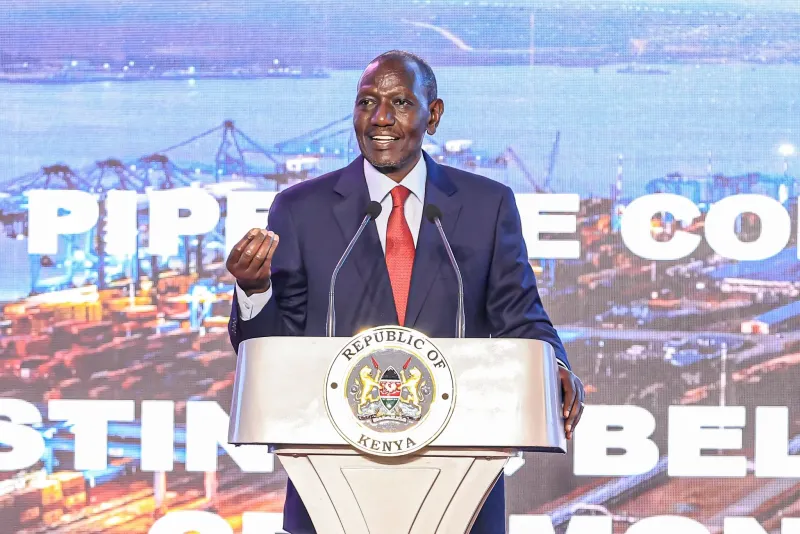





Uganda has acquired a 20.15 percent shareholding in the Kenya Pipeline Company (KPC) following the company’s successful Initial Public Offering on the Nairobi Securities Exchange, marking a major step toward strengthening regional energy cooperation and safeguarding the country’s petroleum supply chain.
The milestone was marked by a bell-ringing ceremony at the Nairobi Securities Exchange officiated by William Ruto, the President of Kenya, signaling the official start of public trading of KPC shares.
Uganda was represented at the ceremony by a delegation led by Irene Bateebe, the Permanent Secretary at the Ministry of Energy and Mineral Development, representing Energy Minister Ruth Nankabirwa. The delegation also included Proscovia Nabbanja, the Chief Executive Officer of the Uganda National Oil Company (UNOC).
Strategic Investment in Fuel Supply Infrastructure
Uganda’s investment in Kenya Pipeline Company highlights the country’s growing commitment to securing its petroleum supply chain. The move builds on earlier developments in the regional oil sector, including Uganda’s strategy to strengthen its role in pipeline infrastructure and fuel logistics across East Africa, as previously reported in our analysis of Uganda’s pipeline investment strategy. https://sunrise.ug/oil-and-gas/202602/uganda-kenya-pipeline-investment
Currently, Uganda imports approximately 95 percent of its petroleum products through Kenya, amounting to nearly 2.96 billion litres of fuel annually. Most of these imports are transported via pipeline from the Port of Mombasa through Kenya’s pipeline network to depots in western Kenya before being transported by road into Uganda.
Because of this heavy reliance, Kenya’s pipeline infrastructure plays a crucial role in ensuring stable fuel supplies for Uganda’s economy.
By acquiring a stake in KPC, Uganda gains strategic participation in one of the region’s most critical energy infrastructure companies.
Strengthening Uganda–Kenya Energy Cooperation
The investment also reflects the growing economic partnership between Uganda and Kenya in the energy sector.
In May 2024, the Uganda National Oil Company signed a Transportation and Storage Agreement with Kenya Pipeline Company, allowing Uganda to utilize the pipeline system transporting petroleum products from the Kenyan coast to inland depots.
This agreement enables oil marketing companies supplying Uganda to access pipeline infrastructure that moves petroleum from Mombasa to western Kenya, from where the fuel is transported to Ugandan markets.
Energy officials say the new shareholding further strengthens that cooperation while improving the reliability of fuel deliveries into Uganda.
Major Milestone for Kenya’s Capital Markets
For Kenya, the listing of Kenya Pipeline Company marks a historic moment in the country’s financial markets.
According to KPC, the IPO is the first government-backed public offering in Kenya in 17 years and has attracted more than 70,000 new investors.
The listing opens ownership of a strategic national infrastructure company to both local and regional investors while providing capital for future expansion.
Officials say the move represents a new model for financing large-scale infrastructure through capital markets rather than relying entirely on government funding.
Regional Impact on Energy Security
Energy experts say Uganda’s investment could have broader implications for regional energy security in East Africa.
With demand for petroleum products continuing to grow across the region, stronger cooperation between Kenya and Uganda in pipeline infrastructure could help reduce supply disruptions and improve fuel distribution efficiency.
The investment also comes as Uganda prepares to become an oil-producing nation with the development of major projects such as the East African Crude Oil Pipeline, which will transport crude oil from Uganda’s oil fields to the Tanzanian coast.
For now, however, Kenya’s pipeline network remains the backbone of Uganda’s fuel import system.
By securing a stake in the company operating that network, Uganda has taken a significant step toward strengthening its long-term energy security while deepening economic ties with its largest regional trading partner.






Sunrise reporter
Leave a Comment
Your email address will not be published.