
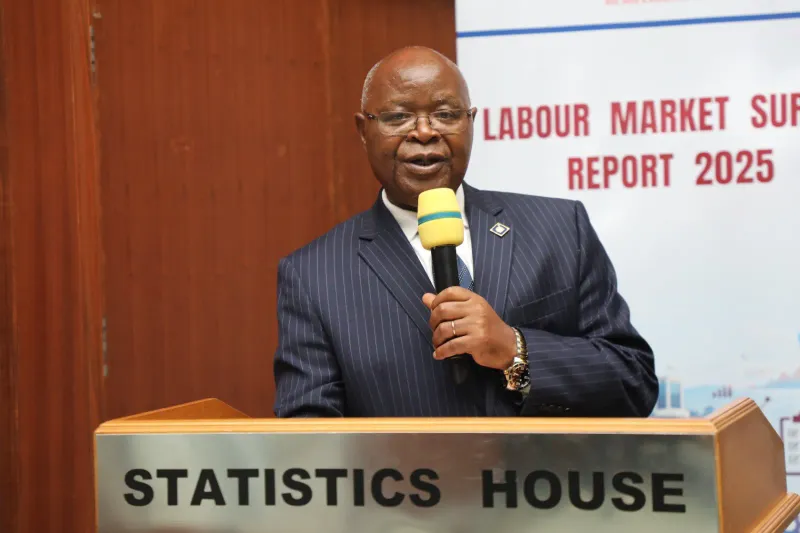





Uganda has released the Labour Market Survey Report 2025 by the Uganda Bureau of Statistics, offering updated insights into employment patterns, labour force structure, and sector performance across the country.
The report was officially launched by Amos Lugoloobi, Minister of State for Finance, Planning and Economic Development, together with other stakeholders. It highlights key developments in Uganda’s labour market at a time when employment remains a national policy priority.
According to UBOS Executive Director Chris N. Mukiza, this marks the fifth dissemination since mid-March, reflecting efforts to improve access to timely statistical data. He noted that UBOS plans to move toward quarterly labour market releases to support more regular, evidence-based policymaking.
UBOS Board Chairman Albert Byamugisha emphasized the importance of reliable statistics, stating, “ Reliable data is not merely a technical requirement it is a strategic national asset that enables informed decision making across Government, the Private Sector, Civil society and Development Partners to make informed decisions that directly improve the livelihoods and drive national transformation,”. He added that quality statistics are essential for effective governance and development planning.
The report shows that 57.6 percent of Ugandans aged 14 to 64 are in the working-age population, with males at 58.8 percent and females at 56.2 percent. Employment-to-population ratios for people aged 15 and above vary by region, with Bunyoro sub-region recording the highest levels and Bukedi the lowest.
Sectoral distribution indicates that the services sector is the largest employer, accounting for 50.5 percent of total employment. Agriculture, forestry and fishing follows at 37.1 percent, while industry accounts for 12.4 percent of employment.
Informal employment remains dominant across the country, with over 70 percent of Uganda’s labour force engaged in the informal sector. Regionally, Karamoja records the highest informal employment at 96.8 percent, followed by Kigezi at 93.7 percent, Teso at 93.0 percent, and Bunyoro at 92.9 percent. Kampala has the lowest share at 73.5 percent, though still significantly high.
The report also highlights persistent challenges, including youth unemployment and underemployment, as well as the underrepresentation of women in formal and higher-paying jobs despite strong participation in the labour force.
UBOS reaffirmed its commitment to providing timely and reliable statistics to guide national development and strengthen labour market planning in Uganda.






Sunrise reporter
Leave a Comment
Your email address will not be published.