
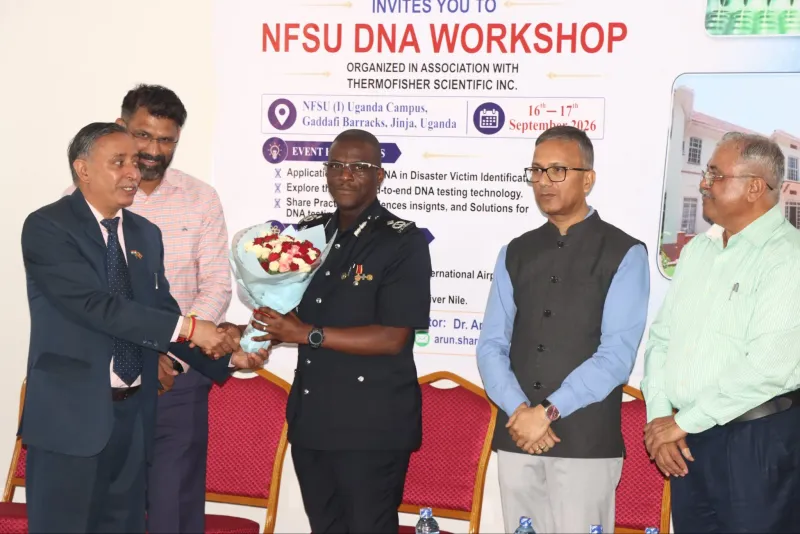





Uganda is expanding its use of rapid DNA technology as forensic experts and law-enforcement officers explore faster ways of identifying suspects, investigating serious crimes and identifying victims of disasters.
The technology was showcased during a two-day forensic workshop held at the National Forensic Sciences University (NFSU) Uganda Campus in Jinja from September 16 to 17, 2026.
The training was organised in partnership with Thermo Fisher Scientific, with participants examining the application of rapid DNA analysis in criminal investigations and disaster victim identification. The system demonstrated during the workshop can generate a DNA profile in about 90 minutes, according to reporting from New Vision.
The development comes as Uganda seeks to strengthen the role of scientific evidence in criminal investigations, particularly where investigators cannot rely on credible eyewitness accounts.
Assistant Commissioner of Police Andrew Kizimule Mubiru, the Director of Forensic Services at the Uganda Police Force, said DNA analysis can help investigators establish links between suspects and crime scenes.
According to Mubiru, biological material such as blood, saliva and sweat recovered from crime scenes can provide forensic evidence in cases including rape, defilement and murder.
He said faster testing could be particularly useful in situations where investigators need to establish a suspect's identity without waiting for samples to be transported over long distances.
New Vision reported that Uganda's forensic laboratories are currently concentrated in Kampala, creating logistical challenges when samples originate from distant parts of the country. Mubiru has called for greater forensic capacity at regional police commands so that frontline investigators can access specialised services closer to where crimes occur.
The rapid DNA technology could therefore become part of broader efforts to reduce delays in forensic investigations, although its use must still operate within established investigative and legal procedures.
Rapid DNA analysis also has applications beyond criminal investigations.
Participants at the Jinja workshop discussed the potential of DNA technology in identifying victims of major disasters, particularly where remains are badly damaged or decomposition makes conventional identification difficult.
New Vision reported that forensic experts highlighted the possible use of teeth and bones for DNA analysis when other biological material has deteriorated.
This capability could be significant for Uganda and other East African countries dealing with incidents such as floods, landslides and other disasters in which victims may be difficult to identify visually.
The workshop brought together forensic and law-enforcement personnel from Uganda and other parts of East Africa, while also exposing NFSU students to advanced forensic techniques.
The sessions covered areas including DNA mixture interpretation, statistical probability and forensic software, according to the UPDF.
NFSU's Uganda Campus was established as the university's first overseas campus and began operations after an agreement between India and Uganda. The campus offers programmes in forensic science, digital forensics, cyber security, crime-scene management and related disciplines.
The university was inaugurated in Jinja in 2023, with the campus located at the Uganda Rapid Deployment Capability Centre at Gaddafi Barracks.
The rapid DNA workshop was held alongside other activities linked to the university's pioneer graduation events.
NFSU also organised a Capture the Flag cybersecurity and digital forensics competition, giving students an opportunity to demonstrate practical skills in investigating and responding to digital threats.
The combination of biological forensics, digital forensics and cybersecurity reflects the increasingly broad role of scientific and technological evidence in modern investigations.
For Uganda's law-enforcement agencies, the immediate focus remains on building the capacity to collect, analyse and interpret forensic evidence effectively. The introduction and demonstration of rapid DNA technology adds another tool to that effort, while proposed regional expansion of forensic services could determine how widely such capabilities become available to investigators outside Kampala.







Sunrise reporter
Leave a Comment
Your email address will not be published.