
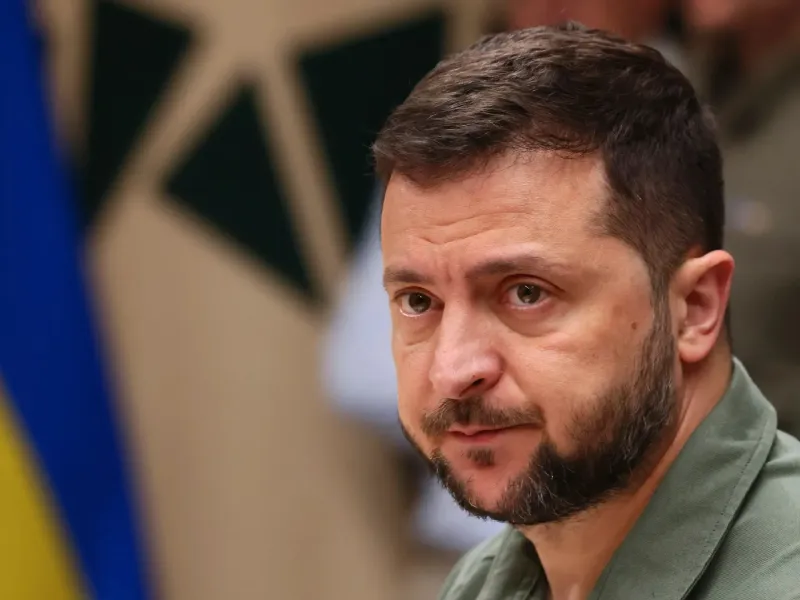





Ukrainian President Volodymyr Zelenskyy says both Ukraine and Russia are working on alternatives to Elon Musk’s Starlink satellite communications network, a development that could reduce the importance of SpaceX’s system on the battlefield as the war continues.
In remarks made public Sunday, Zelenskyy said Russia was developing a Starlink-like system in cooperation with China and believed the project could be ready by December 2026. Ukraine, meanwhile, is testing its own alternative with a European partner, he said.
The announcement is significant because Starlink has become an important part of Ukraine’s wartime communications infrastructure. The satellite network has helped Ukrainian forces maintain communications and operate drones despite damage to conventional communications systems.
But the relationship between Kyiv and Musk has become increasingly complicated. Ukraine has been seeking permission to use Starlink-equipped drones for operations against Russian ballistic-missile launch sites deeper inside Russian territory. A Financial Times report published on August 21 said Kyiv was seeking approval to use the system for strikes as far as 200 kilometers inside Russia.
Zelenskyy said Musk has so far regarded such use as an escalation, but suggested that the SpaceX founder could eventually change his position after further discussions.
That dispute illustrates a larger problem for Ukraine: one of its most important battlefield technologies remains controlled by a private company rather than by the Ukrainian government. While Starlink has provided a crucial communications lifeline, decisions about where and how the network can be used ultimately involve SpaceX.
For Kyiv, developing an independent alternative could therefore be about more than technological competition. It could be an attempt to reduce a strategic dependency that has become increasingly uncomfortable as Ukraine expands its long-range drone operations.
Russia has its own reasons for seeking an alternative. Ukrainian military intelligence said earlier this month that Moscow was accelerating development of Rassvet, a domestic satellite communications system intended to provide capabilities similar to Starlink. According to the Ukrainian assessment, Russia had already begun launching satellites for the system faster than originally planned.
Zelenskyy’s latest comments suggest that the satellite communications race is now becoming another dimension of the Russia-Ukraine conflict. The battlefield is no longer only about tanks, missiles and drones; reliable access to communications from space is increasingly part of military power.
The reported cooperation between Russia and China is particularly noteworthy. Zelenskyy said Moscow and Beijing are working together on a Starlink equivalent that Russia expects to have ready by December. That timetable is a Ukrainian assessment rather than an independently confirmed Russian or Chinese commitment, so it should be treated cautiously.
Even if the December target is missed, the direction is clear. Russia is seeking greater independence from Western-controlled satellite infrastructure, while Ukraine is looking for its own European-backed alternative.
For Ukraine, the stakes are especially high because communications networks have become deeply integrated into modern warfare. Drones need reliable links to operators, commanders need to communicate across dispersed units, and battlefield information has to move quickly between soldiers, command centers and surveillance systems.
Starlink's role has also demonstrated how rapidly commercial technology can become part of national security. What began as a civilian satellite internet service has become closely associated with Ukraine's ability to fight a technologically sophisticated war.
The emergence of competing satellite networks could eventually change that balance. If Russia succeeds in deploying its own system and Ukraine develops a reliable European-supported alternative, neither side would be as dependent on Starlink as it is today.
There is also a broader lesson for Ukraine and its allies. Dependence on a single commercial provider can become a vulnerability during a prolonged conflict, particularly when the provider's owner has his own views about how the technology should be used.
For Musk, the issue presents an equally difficult dilemma. Allowing Starlink to support Ukrainian operations deeper inside Russia could increase the system's military importance but also deepen SpaceX's involvement in an expanding war. Restricting its use may reduce the risk of escalation, but it also encourages Ukraine to seek alternatives.
That search is now underway.
Zelenskyy's announcement suggests that the era in which Starlink was the overwhelmingly dominant satellite communications option for Ukraine may not last indefinitely. Whether Ukraine's European-backed project or Russia's China-linked effort can match Starlink's scale, coverage and reliability remains uncertain.
For now, however, the message from Kyiv is clear: Ukraine does not want its future battlefield communications to depend indefinitely on Elon Musk's decisions. And Russia appears to be pursuing the same goal from the opposite side of the conflict.
The race to build alternatives could therefore become one of the less visible but increasingly important technological contests of the war.






Sunrise reporter
Leave a Comment
Your email address will not be published.