
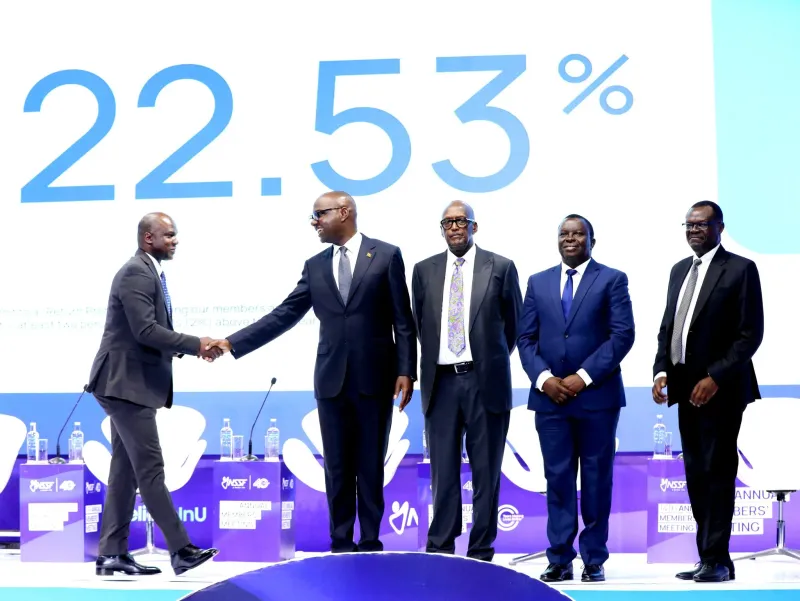



The National Social Security Fund (NSSF) has declared a 22.53% interest rate for members’ savings for the financial year 2025/26, translating into UGX 5.44 trillion in interest to be credited to members.
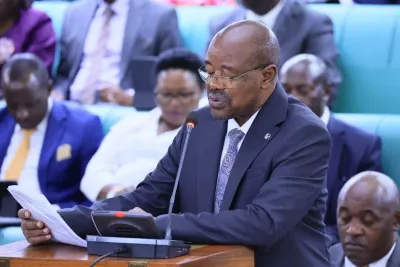
The rate was announced by the Minister of Finance, Planning and Economic Development, Hon. Henry Musasizi, during NSSF’s 14th Annual Members’ Meeting.
According to the Ministry of Finance, the 22.53% rate represents the highest interest rate in the history of NSSF and is significantly higher than the 13.5% rate declared for the previous financial year. The UGX 5.44 trillion interest payout is also higher than the UGX 2.79 trillion shared with members in the previous year.
The 22.53% interest rate applies to NSSF members for the financial year ended June 30, 2026.
Minister Musasizi said the return is above Uganda’s reported 10-year average inflation rate of 4.1% and the 3.7% inflation recorded at the end of June 2026, meaning the declared return was substantially above the rate at which consumer prices had risen over those periods.
The Minister commended NSSF for its financial performance and its position as the largest pension fund in East Africa.
He also linked the growth of domestic savings to Uganda’s long-term economic ambitions, noting that the country’s savings rate needs to increase to support the level of investment required for economic growth.
NSSF Managing Director Patrick Ayota reported that the Fund’s total assets reached UGX 32.87 trillion by June 2026, an increase of approximately UGX 6.86 trillion in one year.
The Fund also reported that it had 3.6 million registered members, of whom 2.7 million had savings balances.
During the financial year, 311,730 new members joined NSSF.
Member and employer contributions increased by 13.7% to UGX 2.42 trillion, compared with UGX 2.13 trillion in the previous financial year.
NSSF also reactivated 55,000 dormant members during the year.
The Fund paid UGX 1.55 trillion in benefits to 50,499 members during FY 2025/26.
Ayota said NSSF deployed UGX 4.54 trillion in investments during the financial year, with UGX 4.32 trillion invested in Uganda.
About 76% of the Fund’s domestic investments were in bonds, alongside investments in equities and real estate.
The Fund also held approximately UGX 10.2 trillion in regional investments across Kenya, Tanzania and Rwanda, as part of its diversification strategy.
NSSF said its investment activities are intended to generate returns for members while also supporting economic activity.
The Fund also reported improvements in its service delivery.
According to Ayota, member satisfaction increased to 89%, while the average benefits payment turnaround time fell to 4.5 days.
The Fund’s voluntary savings product, Smartlife Flexi, recorded more than UGX 180 billion in voluntary contributions during its first 20 months.
NSSF said the product is part of its efforts to make long-term saving accessible to more Ugandans.
Under its Vision 2035 strategy, NSSF is targeting 15 million savers, equivalent to about 50% of Uganda’s working population.
The Fund has also set a target of growing members’ savings to UGX 80 trillion and achieving 95% stakeholder engagement.
Ayota said expanding social security coverage remains one of the Fund’s key ambitions as more Ugandans enter the formal and informal economy.
The Fund is encouraging farmers, market vendors, students, boda boda riders and other informal-sector workers to take advantage of available NSSF savings products.
The Auditor General, Edward Akol, said he had audited NSSF’s financial statements covering the year ended June 30, 2026.
Akol said the audit was conducted through KPMG Certified Public Accountants, appointed on his behalf in accordance with the National Audit Act.
In his opinion, the financial statements presented a true and fair view of the financial position of NSSF as of June 30, 2026, as well as its financial performance and cash flows for the year.
The audit was conducted in accordance with International Financial Reporting Standards and the requirements of the NSSF Act.
NSSF Board Chairman Dr. David Ogong said the Fund’s financial statements had received an unmodified audit opinion, describing the independent audit as important to members’ confidence in the figures presented by the Fund.
Ogong noted that NSSF’s assets had grown from approximately UGX 22 trillion in June 2024 to about UGX 32.8 trillion by June 2026.
He added that since the beginning of the new financial year, the Fund’s assets had increased by approximately UGX 1.9 trillion, reaching about UGX 34.7 trillion at the time of the Annual Members’ Meeting.
He said the Fund must continue making sound decisions because members entrust NSSF with their savings and future financial security.
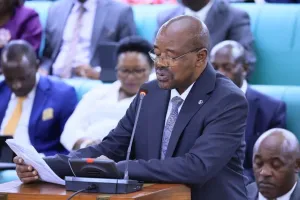
The Minister for Gender, Labour and Social Development, Rtd. Lt. Gen. Henry Tumukunde, welcomed NSSF’s financial performance but called for continued improvements in coverage, operational efficiency and resource optimisation.
Tumukunde said NSSF should make social security more inclusive and responsive to the realities of modern savers.
He said inclusion should involve not only enrolling eligible workers but also reducing barriers to registration, simplifying processes and ensuring that social security services remain relevant throughout a member’s journey with the Fund.
The Minister also stressed the need for transparency, accountability and fiduciary responsibility.
He said the money managed by NSSF represents private savings of workers and must therefore be protected from erosion of value, invested prudently and applied to initiatives that generate measurable value for savers.
Finance Minister Musasizi said Uganda’s savings rate currently stands at 24% of GDP but needs to rise to 40% by 2040 to support the country’s investment requirements.
He linked this objective to the Government’s Tenfold Growth Strategy, which targets expanding Uganda’s economy to US$500 billion by 2040.
Musasizi said increased mobilisation of domestic savings and investment would be necessary to support that ambition.
He also pledged Government support to ensure that NSSF operates in a competitive environment, including faster decisions on viable and time-sensitive investment opportunities.
NSSF also highlighted its wider contribution to the Ugandan economy, including UGX 301 billion in taxes during the financial year.
The Fund said its strategy is focused on expanding access to social security, creating greater capacity for Ugandans to save and investing members’ money to generate long-term value.
The declaration of the 22.53% NSSF interest rate therefore comes against a year of growth in assets, contributions, membership, investments and benefits paid.
For NSSF members, the key outcome is the UGX 5.44 trillion in interest to be credited to their savings for FY 2025/26.




Jason Olinga
Leave a Comment
Your email address will not be published.