
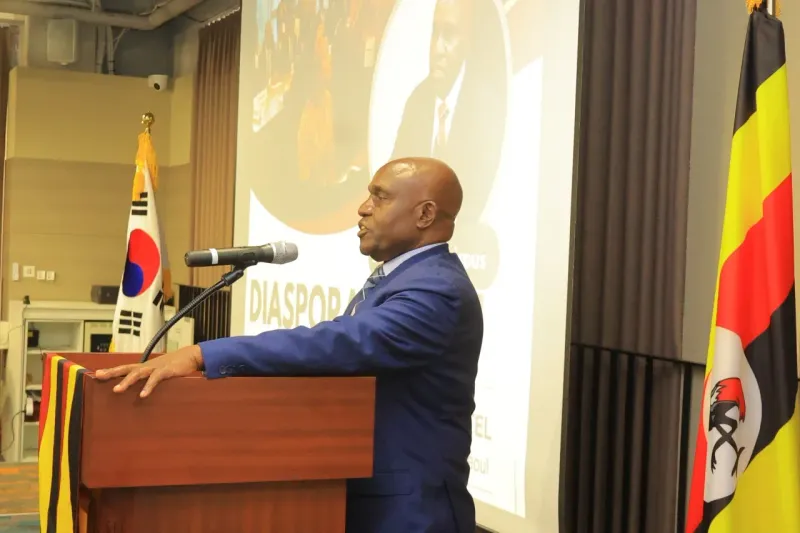


Uganda is turning to its diaspora community in South Korea to help drive investment, trade, technology transfer and economic development as Kampala seeks to deepen commercial ties with the Asian economic powerhouse.
The appeal was made during a diaspora engagement in Seoul ahead of the Uganda–Korea Trade and Investment Meeting, scheduled for September 6–10, 2026, in partnership with the Korea International Trade Association (KITA).
The outreach was hosted by the Uganda Embassy in Tokyo, which is accredited to the Republic of Korea, bringing together Ugandans living and working in South Korea and senior officials from Kampala.
Uganda’s Ambassador to Korea, H.E. Tophace Kaahwa, urged Ugandans in South Korea to use their financial resources, professional expertise, business networks and access to technology to support Uganda’s economic transformation.
Kaahwa identified several areas where the diaspora could play a greater role, including agro-business, tourism, mineral development, science, technology and innovation.
She also encouraged Ugandans abroad to facilitate technology transfer and skills development, arguing that experience gained in South Korea could contribute to building capacity and creating opportunities back home.
The engagement comes as Uganda seeks to strengthen economic diplomacy and attract more investment from South Korean businesses.
Uganda's Ministry of Foreign Affairs had previously announced plans for an investment meeting with KITA, highlighting technology transfer and investment promotion in agro-industrialisation, tourism, mineral development and science, technology and innovation as priority areas.
The Second Deputy Prime Minister and head of the Ugandan delegation, Rt. Hon. Dr. Crispus Kiyonga, conveyed greetings from President Yoweri Kaguta Museveni and praised Ugandans in South Korea for their contribution to the country.
Kiyonga pointed to infrastructure development, energy, industrialisation and private-sector investment as critical areas for Uganda's economic transformation.
He also highlighted the government's ambition to expand the Ugandan economy to US$500 billion by 2040, with increased investment and productive capacity expected to play a central role.
The government has increasingly placed economic diplomacy at the centre of its efforts to attract capital, technology and markets from international partners.
Uganda's diaspora community in South Korea is estimated at more than 650 people, giving the community an important role in strengthening economic and people-to-people links between the two countries.
Beyond sending money home, the government is encouraging Ugandans abroad to contribute through entrepreneurship, investment, knowledge exchange, professional networks and technology.
The diaspora policy agenda is intended to improve coordination between the government and Ugandans living overseas while creating more opportunities for them to participate in national development.
For Uganda, the Korean community offers a potentially valuable link to one of Asia's major industrial and technology economies.
The latest trade and investment engagement builds on an expanding economic relationship between Uganda and South Korea.
In June 2024, Uganda and South Korea signed a US$500 million framework agreement under Korea's Economic Development Cooperation Fund (EDCF). The agreement covers the 2024–2028 period and provides for financing for infrastructure projects in Uganda.
The two countries have also been exploring opportunities for greater Korean investment and technology transfer in Uganda.
In November 2025, Uganda's Permanent Secretary in the Ministry of Foreign Affairs, Bagiire Vincent Waiswa, met KITA Vice President Gi-Hyun Kim in Seoul. The discussions included plans for a Uganda–Korea investment meeting and cooperation in agro-industrialisation, tourism, mineral development and science, technology and innovation. KITA indicated its willingness to work with Uganda in organising the investment engagement.
The latest meeting therefore represents a continuation of efforts to move the relationship beyond traditional development cooperation towards stronger commercial and investment ties.
For Uganda, attracting Korean investment is not only about securing capital. The government is also seeking access to technology, expertise, manufacturing capabilities and international business networks.
South Korea's own transformation from a relatively poor, aid-receiving country into a highly industrialised economy has made its development experience particularly relevant to countries such as Uganda. Uganda's Development Finance Ministry has previously highlighted South Korea's emphasis on exports, human capital, infrastructure, research and development and long-term economic planning as important elements of its development experience.
Uganda hopes similar partnerships can support industrialisation, increase value addition to local products and expand access to international markets.
The diaspora could be an important part of that process because Ugandans living in South Korea have direct exposure to the country's business environment, technologies, institutions and markets.
As the Uganda–Korea Trade and Investment Meeting gets underway, government officials are looking to turn existing diplomatic relations into deeper economic partnerships.
For Ugandans in South Korea, the government is seeking a role that goes beyond representing Uganda abroad. It wants the diaspora to become investors, entrepreneurs, technology links, skills providers and commercial connectors.
If successfully developed, those networks could help Ugandan businesses access Korean partners while giving South Korean companies greater exposure to investment opportunities in Uganda.
The September 2026 engagement therefore comes at a significant moment in Uganda–Korea relations, with trade, investment, infrastructure, technology transfer and diaspora participation increasingly forming part of the countries' broader economic cooperation agenda.


Sunrise reporter
Leave a Comment
Your email address will not be published.