
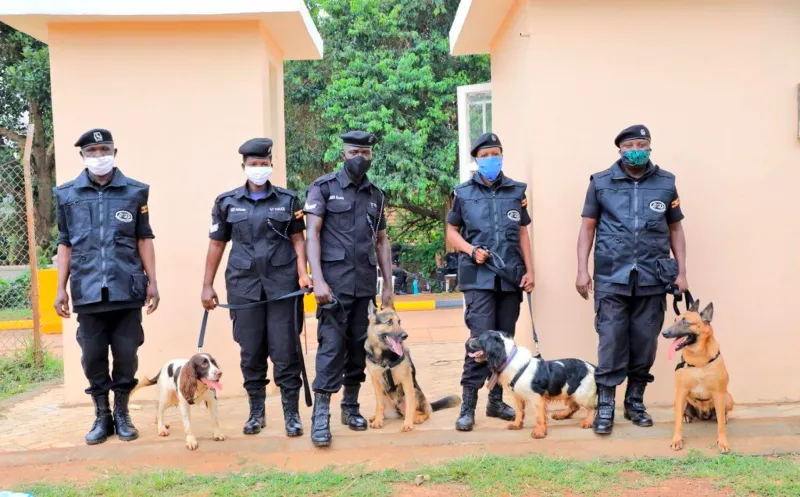




Uganda’s decision to locally breed sniffer dogs has transformed policing, cut costs dramatically, and strengthened crime detection across the country. Twelve years after the Uganda Police Force abandoned reliance on imported canine units, the Naggalama Police Canine Breeding Centre in Nakifuma County, Mukono District, is now a cornerstone of national security operations.
The breeding centre was created in response to the high financial and operational burden of importing fully trained sniffer dogs. At the time, a single imported dog cost more than USD 10,000 (approximately 36 million Shillings), excluding maintenance and medical expenses. According to Police Canine Unit Commandant Martin Mugume, the real costs went far beyond the purchase price.
“It was not just about buying the dogs,” Mugume explains. “Maintenance was extremely costly. Whenever a dog fell sick, we had to consult foreign suppliers for treatment or advice. In some cases, dogs failed to adapt to the terrain and climate, while others died within three months.”
Uganda’s hot climate and rugged terrain proved challenging for many imported dogs, reducing their effectiveness and lifespan. By contrast, dogs bred at Naggalama grow up in the same environment where they later serve, making them more resilient, adaptable, and dependable in the field.
Today, the impact of that strategic shift is evident nationwide. Sniffer dogs bred at Naggalama are deployed in all 120 districts of Uganda. If the police had continued importing canine units at previous prices, the cost would have exceeded 4.3 billion Shillings. Instead, raising and training a sniffer dog locally, from puppyhood to active deployment, costs no more than 7 million Shillings per dog.
While the police have not disclosed the total number of dogs currently in service, available figures show that at least 20 dogs are attached to the Counter-Terrorism Directorate alone. In the Kampala Metropolitan area, 16 of the 21 police divisions have sniffer dogs, while more than 30 canine units are deployed at Entebbe International Airport. Major towns such as Masaka, Mbarara, Jinja, Mbale, and Arua each host multiple dogs at their Central Police Stations, and all national border points are covered by dogs bred at Naggalama.
Over the past 12 years, deploying canine units to police divisions, districts, border points, customs facilities, Entebbe International Airport, and other strategic locations would have cost more than 7.8 billion Shillings if the dogs were imported. The local breeding program has reduced these expenses by more than 80 per cent, ensuring long-term sustainability while maintaining operational readiness.
Beyond financial savings, the canine unit has become a critical tool in crime fighting. In its annual crime reports for 2022, 2023, and 2024, the Criminal Investigations Directorate (CID), led by Maj Tom Magambo, praised sniffer dogs for significantly speeding up investigations.
Data from the past three years shows that more than 12,000 suspects have been arrested annually with the assistance of canine units. These arrests span a wide range of offences, including theft, burglary, robbery, murder, and sexual crimes such as rape.
Sniffer dogs have also played a central role in aviation security. At Entebbe International Airport alone, canine units handled 45 cases involving abandoned items and suspicious objects within a five-month period last year. Police also responded to 67 requests to sweep suspicious flights, investigated 1,054 cases involving suspicious cargo, conducted 36 canine sweeps at Aviation Police Headquarters, and answered 181 canine assistance requests at Nsambya Headquarters.
The progress at Naggalama has drawn praise from senior leadership. During a recent visit, Inspector General of Police Abas Byakagaba commended Commandant Mugume for expanding and professionalising the canine service.
“I am impressed by the progress made at this canine centre, and I commit myself to further improving its standards,” the IGP said.
The initiative has also received backing at the highest political level. President Yoweri Museveni previously rejected a proposal to import sniffer dogs for the Civil Aviation Authority. The proposal, submitted by a company led by the late Cedric Ndilima, was declined after the President expressed confidence in the effectiveness of police-provided dogs already operating at Entebbe International Airport.
Despite the success of the program, Mugume stresses that public cooperation remains essential. He encourages citizens to preserve crime scenes and request canine tracking services as early as possible, noting that timely deployment often determines whether investigations succeed or critical leads are lost.
He also warned against misuse of the service by officers.
“Sniffer dogs are not for sale,” Mugume said, urging members of the public to report any officers who demand money in exchange for deploying canine units.
With its combination of cost efficiency, operational effectiveness, and growing national coverage, the Naggalama Police Canine Breeding Centre stands as one of Uganda’s most impactful homegrown security initiatives, proving that local solutions can outperform costly imports when properly supported and professionally managed.
URN






The Sunrise Editor
Leave a Comment
Your email address will not be published.