
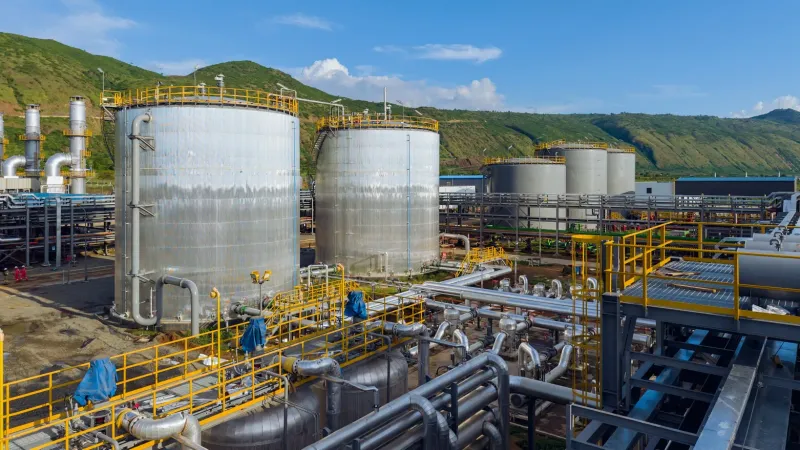





Uganda's journey towards first oil continues to gather momentum, with the country's major petroleum infrastructure projects registering significant progress while creating more opportunities for Ugandan workers and businesses.
According to the latest project update as of June 30, 2026, the Tilenga Project has reached 74% completion, with 234 wells drilled, surpassing the minimum requirement of 170 wells needed for production.
The Kingfisher Project has also recorded steady progress, reaching 79% completion. Construction of the project's Central Processing Facility (CPF) and feeder pipeline is nearing completion, marking another important step towards commercial oil production.
Meanwhile, the East African Crude Oil Pipeline (EACOP) has achieved 90% overall completion, with more than 1,443 kilometres of pipeline welded across Uganda and Tanzania. The cross-border pipeline will transport Uganda's crude oil from the Albertine Graben to Tanzania's port of Tanga for export, making it a critical component of the country's petroleum value chain.
Progress is also being made on the Uganda Refinery Project, where pre-Final Investment Decision (pre-FID) technical studies had reached 28% completion by the end of June 2026.
The four projects, Tilenga, Kingfisher, EACOP and the Uganda Refinery Project, form the backbone of Uganda's strategy to commercialise its petroleum resources through upstream production, transportation and value addition.
Alongside construction milestones, Uganda continues to register growth in national participation within the petroleum sector through increased employment and local business involvement.
By the end of June 2026, the sector employed 22,234 people, of whom 18,958 were Ugandans, representing 85% of the total workforce.
Local companies are also securing a growing share of petroleum contracts. Data from the Petroleum Authority of Uganda shows that the cumulative value of approved Tier 1 contracts had reached US$7.686 billion, with approximately US$2.298 billion, representing 30%, awarded to Ugandan companies.
The country's National Supplier Database has also continued to expand, with 2,635 companies from 39 countries registered by the end of June. Of these, 2,277 companies are Ugandan, reflecting continued efforts to strengthen local content and increase the participation of domestic enterprises in the petroleum industry.
During the quarter ending June 30, 2026, the Petroleum Authority of Uganda also approved 30 Bid Evaluation Reports, including eight Tier 1 contracts worth US$53.832 million, of which US$8.748 million was awarded to Ugandan companies, as well as nine Tier 2 contracts valued at US$2.572 million.
The latest milestones underscore Uganda's continued progress in developing the infrastructure required to commercialise its petroleum resources. As construction advances across the country's flagship oil projects and local participation continues to expand, the petroleum sector remains on course towards achieving Uganda's first oil while increasing opportunities for Ugandan workers and businesses.






Chrispus Mutaahi
Leave a Comment
Your email address will not be published.